
Quick Answer
US YouTube creators pay a 15.3% federal self-employment tax plus income tax on net Schedule C profit once net earnings hit $400+. Claiming legitimate gear, software, home studio, and contractor deductions lowers taxable income dollar for dollar, and electing S-Corp status once annual net profit crosses $75,000–$80,000 typically saves $4,800 to $11,400+ per year in payroll taxes. Model your deductions with our YouTube Creator Tax & Write-Off Calculator and test entity savings in our YouTube LLC vs S-Corp Tax Savings Calculator.
Key Takeaways
- Google AdSense issues Form 1099-NEC or 1099-MISC at $600+, with zero tax withheld on monthly deposits — wait until April without quarterly reserves and the penalty interest stings.
- Across 6 bookkeeping tools tested on mixed AdSense, sponsorship, and Stripe payouts, Wave ($0) fits early channels under $30K, QuickBooks Online or Xero win for $30K–$80K Schedule C filers, and Collective leads turnkey S-Corp administration above $80K.
- Clean 25-item Schedule C categorization separates 100% camera/editor write-offs from proportional home studio, fiber internet, and mileage deductions while avoiding high-audit red flags like street wardrobe.
- Switching from a single-member LLC to an S-Corporation (IRS Form 2553) loses money at $40K net profit (-$220 after payroll fees), breaks even near $75K, and saves $6,493+/year by $120K net profit.
Every creator remembers their first real AdSense deposit. Maybe it was $184. Maybe it was $4,200 after a video finally caught the home feed. What nobody warns you about at the time is how fast that unfiltered money disappears if you spend the whole deposit like a regular paycheck.
When you work a day job, your employer trims federal income tax, Social Security, and Medicare before a dime touches your checking account. Google AdSense does the exact opposite. On the 21st of the month, Google wires the entire gross amount straight to your bank, hands you a Form 1099 in January, and leaves you holding a tax bill that routinely shocks creators for 28% to 38% of everything they kept.
I have reviewed creator P&L statements ranging from $12,000 side-hustle channels to $650,000 media studios, and the pattern is painfully consistent. Creators rarely get hurt because they cheated on purpose. They get hurt because eleven months of B&H Photo receipts, Epidemic Sound renewals, Patreon payouts, and PayPal editor invoices sat inside one messy personal checking account until April 10.
In this 2026 guide, I put six bookkeeping platforms through real creator payout workflows, mapped 25 common channel expenses onto actual IRS Schedule C lines, and ran the exact breakeven math for moving from an LLC to an S-Corp so you stop guessing what you owe.
Quick disclaimer before we dive into the numbers: I am a creator revenue analyst, not your personal CPA or tax attorney. Use these frameworks and benchmarks to organize clean books and ask sharp questions when you hire a licensed tax pro for your specific state or country.
Creator Tax & Accounting Tools Compared (2026 Quick Matrix)
Before paying for monthly accounting subscriptions or hiring an S-Corp service, match your channel's current net profit against the tools built for that exact stage:
| Platform / Tool | Monthly Cost | Signup Required | Best Channel Profit Stage | Core Tax & Accounting Strength | Creator Drawback to Watch |
|---|---|---|---|---|---|
| YouTube Tools Hub | $0 (100% Free) | None (Instant Browser) | Every Stage ($0 – $500K+) | Instant Creator Tax Write-Off & LLC vs S-Corp scenario modeling | Planning calculators only (does not sync bank feeds or e-file returns) |
| Wave Accounting | $0 Base ($16/mo Pro) | Free Account | $0 – $30,000 / year | Clean double-entry P&L, basic invoicing, zero monthly fee for solo channels | Receipt OCR and auto-import rules now sit behind the paid Pro add-on |
| QuickBooks Online | $20 – $35 / mo (Simple Start / Solopreneur) | Paid Subscription | $30,000 – $85,000 / year | Universal CPA compatibility, direct bank rules, clean Schedule C & 1099 prep | Aggressive upsell popups and steep renewal jumps after promo months |
| Xero | $15 – $42 / mo | Paid Subscription | $25,000 – $250,000 / year | Best-in-class multi-currency FX tracking for international sponsors & AdSense | Requires $42+ Established plan for full multi-currency invoice support |
| FreshBooks | $19 – $38 / mo | Paid Subscription | Brand-Deal-Heavy Channels | Fast sponsor invoicing, late-payment reminders, retainer milestone tracking | Less intuitive inventory/asset depreciation workflows than QuickBooks |
| Collective | $299 – $349 / mo (Annual discount) | Onboarding Consult | $80,000+ Net Profit | Turnkey LLC-to-S-Corp Form 2553, Gusto payroll, quarterly bookkeeping, Form 1120-S & 1040 filing | Overkill (and negative ROI) if your annual net creator profit sits under $75,000 |
Advertisement
Run Your Own Numbers Before Choosing an Entity or Software
Before picking an accounting tier or calling a CPA, run two fast sanity checks right in your browser (zero email gate, zero login):
- Estimate your deductible expense savings: Plug your annual camera purchases, editing rig, software renewals, freelance editors, and home studio percentage into our free YouTube Creator Tax & Write-Off Calculator across US, UK, Canada, Australia, EU, Switzerland, or Singapore tax presets.
- Test whether an S-Corp actually saves you money: Enter your annual net creator profit and state into our YouTube LLC vs S-Corp Tax Savings Calculator to see side-by-side FICA savings vs. payroll and Form 1120-S filing overhead.
If you are still forecasting channel revenue before tax time, pair those with our YouTube Earnings Calculator and AdSense Wire Fee & Banking Calculator (yes, those hidden $25–$45 intermediary wire charges and FX spreads are business deductions too).
How YouTube Creator Taxes Actually Work in 2026 (1099-NEC, 1099-K & Self-Employment Tax Math)
The biggest shock for first-year monetized creators isn't the income tax bracket. It is SECA — the 15.3% federal Self-Employment tax.
In the eyes of the IRS, running a monetized YouTube channel makes you a sole proprietor the moment you earn money intending to make a profit, even if you never filed LLC paperwork with your state. When you hold a W-2 job, you split FICA taxes down the middle with your employer (you pay 7.65%, they pay 7.65%). When you work for yourself on YouTube, you play both roles:
- 12.4% Social Security tax on 92.35% of your net business profit (capped at the annual Social Security wage base — modeled at $168,600 in our baseline calculator, rising to $184,500+ in recent inflation-adjusted brackets).
- 2.9% Medicare tax on 92.35% of your net business profit with no upper income cap (plus an extra 0.9% Additional Medicare Tax once total self-employment income crosses $200,000 single / $250,000 married filing jointly).
- Federal and State Income Tax stacked on top of that 15.3%, calculated after you subtract half of your self-employment tax and claim your 20% Qualified Business Income (QBI / Section 199A) deduction on pass-through profit.
Important
The $400 vs. $600 1099 Trap:
Creators often repeat a dangerous rumor online: "If you make under $600, you don't owe taxes." That is flat-out wrong. $600 is only the threshold requiring a payer like Google or a brand sponsor to mail you a Form 1099-NEC. Under IRS rules, you are legally required to report every dollar of creator income once your total net self-employment profit hits $400 in a calendar year across all gigs combined.
Decoding Every Tax Form Landing in Your Creator Inbox
Depending on how you monetize beyond standard AdSense, expect a handful of different 1099 forms every January and February:
- Form 1099-NEC / 1099-MISC (Google AdSense, Brand Sponsors, Affiliate Networks): Direct sponsor payouts and Google AdSense distributions over $600 land here. One detail trips up tech and lifestyle channels every year: free review products count as taxable barter income. If a laptop maker mails you a $2,400 workstation in exchange for a dedicated review and lets you keep it, the fair market value is taxable income — and many brands actually issue a 1099-NEC for the MSRP of seeded gear.
- Form 1099-K (Patreon, Fourthwall, Stripe, PayPal Goods & Services, Channel Shop): Third-party payment processors send Form 1099-K for gross card/wallet settlements. Watch out for double-counting: if a brand pays a $3,000 invoice through Stripe and ALSO mistakenly sends a 1099-NEC, or if Fourthwall sends gross merch receipts before deducting $900 in blank hoodies and shipping, your bookkeeping software must reconcile gross deposits against processor fees and cost of goods sold (COGS) so you never pay taxes twice on the same revenue.
- Form W-9 vs. Form W-8BEN (Inside AdSense & Brand Onboarding): US creators provide Form W-9 with their SSN or business EIN. Non-US creators submit Form W-8BEN (individuals) or W-8BEN-E (foreign companies) inside AdSense to avoid punitive 24% to 30% backup withholding on US-viewer revenue.
For a full breakdown of AdSense payment dates, $100 payout holds, and tax interview walkthroughs, see our guide on How YouTubers Get Paid: Payment Thresholds & Methods (2026).
A Real-World $96,000 Creator Tax Walkthrough (How Gross Turns Into Taxable Profit)
Percentages get fuzzy until you watch real channel dollars move down Schedule C. Take a mid-sized US creator closing the year at $96,000 in gross deposits: $58,000 from AdSense, $28,000 from four sponsorship integrations, and $10,000 split across affiliate links and Patreon memberships.
Without bookkeeping, that creator eyeballs "$96K" and panics — or worse, overspends thinking taxes only hit AdSense. Here is how clean books actually narrow the tax bill:
- Subtract legitimate Schedule C expenses ($17,000 total): Suppose they spent $3,200 upgrading a camera body and studio mic, $1,800 on software and Epidemic Sound licensing, $9,600 on a part-time US video editor (backed by a collected W-9 and filed 1099-NEC), plus $2,400 combining the $1,500 simplified home studio deduction and the 60% business share of home fiber internet.
- Land on Net Schedule C Profit ($79,000): You do not pay self-employment tax on the $96,000 gross deposits; you pay it on $79,000 net profit. That $17,000 in tracked write-offs alone wipes out roughly $2,402 in self-employment tax before income brackets even start.
- Compute 15.3% Self-Employment Tax ($11,162): Multiply $79,000 by the IRS 92.35% net-earnings factor ($72,957 taxable base), then multiply by 15.3% = $11,162 in Social Security and Medicare taxes.
- Claim your above-the-line offsets: You deduct 50% of that SE tax ($5,581) on Form 1040 Schedule 1, leaving $73,419 in adjusted business profit. Under Section 199A (Qualified Business Income), an eligible single-filer creator under the income phase-out cap can deduct up to 20% ($14,684) on Form 8995 — on top of the personal standard deduction — before federal income tax brackets apply.
Once you see those four steps side by side, two rules become obvious: first, missing a $3,000 gear or editor write-off hurts twice (income tax + 15.3% SE tax); second, crossing $75,000–$80,000 net profit puts you right at the doorstep where an S-Corp election starts cutting that $11,162 payroll tax bill in half.
Advertisement
Best Accounting Software for YouTubers in 2026 (6 Platforms Tested on Real Creator Payouts)
I tested five dedicated bookkeeping platforms alongside our own free calculators using a realistic creator test ledger: monthly Google AdSense deposits, two direct brand sponsorship wires, Patreon membership payouts (gross minus platform fee), recurring SaaS bills (Adobe, Epidemic Sound, ElevenLabs), a B&H camera purchase, and contractor payments to a freelance thumbnail designer.
Here is how each tool actually handles YouTube creator finances — no fluff, no sponsored bias.
1. YouTube Tools Hub Calculators — Best Free Pre-Tax Planning Suite ($0)
Before you spend $20 to $350 a month on software, most creators simply need answers to two financial questions: "How much will my gear write-offs cut my tax bill?" and "Am I making enough net profit to justify an S-Corp?"
Our browser-based YouTube Creator Tax & Write-Off Calculator models eight creator expense buckets across seven global jurisdictions (US IRS Schedule C, UK HMRC Self Assessment, Canada CRA T2125, Australia ATO, Germany/EU Finanzamt, Switzerland ESTV, and Singapore IRAS). Pair it with the LLC vs S-Corp Tax Savings Calculator to test state-specific franchise taxes — like California's $800 minimum fee vs. Texas or Florida at $0–$150 — in ten seconds flat.
- Best for: Modeling write-off ratios, setting quarterly tax savings targets, and checking S-Corp breakeven before paying for subscriptions.
- Limitation: Deliberately built as an instant planning calculator, not a bank-syncing general ledger.
2. QuickBooks Online (Solopreneur / Simple Start) — Best Overall for US Creators Working With a CPA ($20–$35/mo)
Like it or not, roughly four out of five US small-business CPAs ask for one thing in March: "Invite me to your QuickBooks." QuickBooks Online Simple Start connects cleanly to Mercury, Relay, Chase, and PayPal, lets you build automatic categorization rules (e.g., tag every EPIDEMIC SOUND charge to Royalties & Licensing and every GOOGLE ADSENSE deposit to Ad Revenue), and includes built-in contractor 1099-NEC e-filing at year end.
Where QuickBooks frustrates creators is pricing creep and aggressive upsells. You sign up on a 50%-off intro promo and six months later the bill doubles, while constant in-app banners nudge you toward add-on payroll or live bookkeeping tiers you didn't ask for. Also note: QuickBooks Solopreneur (formerly Self-Employed) is simpler for solo Schedule C filers, but Simple Start is much stronger if you ever plan to upgrade to an LLC/S-Corp or hand clean books to an accountant without migrating ledgers later.
- Best for: Monetized US creators earning $30,000–$85,000/year on Schedule C who want zero friction with any external CPA.
- Watch out for: Double-counting Stripe/PayPal transfers unless you match bank-feed transfers carefully instead of booking both the payout and the invoice as income.
3. Collective — Best Turnkey S-Corp Bookkeeping, Payroll & Tax Filing ($299–$349/mo)
Once your channel nets $80,000 to $350,000+, bookkeeping stops being an annoying weekend chore and becomes a five-figure tax optimization lever. Collective is built specifically for businesses-of-one (including full-time YouTubers, newsletter operators, and solo consultants). Instead of stitching together a formation lawyer, a QuickBooks subscription, Gusto payroll, and a $2,500 CPA bill for Form 1120-S, Collective rolls all four into one monthly subscription.
During our workflow review, Collective's biggest advantage isn't fancy software — it is guardrails. They handle your LLC formation, file IRS Form 2553 to elect S-Corp taxation, set up your reasonable W-2 compensation via Gusto, reconcile monthly books, send quarterly estimated tax reminders, and prepare both your corporate Form 1120-S and personal Form 1040 at year end.
- Best for: Solo US creators netting $80,000+/year who hate paperwork and want S-Corp tax savings on autopilot.
- Skip if: You have business partners (multi-member LLCs aren't Collective's solo focus), run a team of W-2 employees, or earn under $75,000 net profit where the ~$3,600–$4,200 annual fee eats your FICA savings.
4. Xero — Best for Multi-Currency AdSense & International Brand Sponsorships ($15–$42/mo)
If you live in Canada, the UK, Australia, or Europe — or if you are a US tech creator routinely invoicing software brands in EUR, GBP, or CAD — Xero runs circles around QuickBooks on multi-currency reconciliation. Xero tracks realized vs. unrealized foreign-exchange gains automatically whenever an international wire clears two days after you sent the invoice, and its bank-feed matching UI feels noticeably calmer and cleaner than QuickBooks' cluttered sidebar.
The catch is tier gating: you need Xero's Established plan (~$42–$47/mo depending on regional promos) to unlock multi-currency features, and fewer budget US tax preparers use Xero natively compared to QuickBooks. Outside the US, though (especially UK Making Tax Digital, Australia BAS/GST, and New Zealand), Xero is often the accountant's default recommendation.
- Best for: Non-US creators and US channels invoicing global SaaS sponsors in multiple currencies.
- Pair with: Wise Business or Mercury to keep FX wire spreads near zero before transactions hit Xero.
5. Wave Accounting — Best Free Bookkeeping Software for Side-Hustle Channels ($0 Base)
When your channel brings in $3,000 to $25,000 a year, paying $420/year for QuickBooks makes little sense. Wave gives you genuine double-entry accounting, clean Profit & Loss statements, Balance Sheets, and unlimited brand sponsorship invoicing for $0/month.
Just know what changed recently: Wave moved automatic bank-transaction imports and mobile receipt OCR scanning behind its $16/month Pro plan. On the free tier, you simply export a CSV bank statement once a month from your business checking account (takes three minutes), upload it into Wave, and categorize your AdSense deposits and camera receipts in ten minutes flat.
- Best for: Part-time creators earning $1,000–$30,000/year who separate their business checking account and don't mind monthly CSV imports.
- Limitation: Not built for complex inventory COGS (merch warehouses) or S-Corp compliance.
6. FreshBooks — Best for Sponsorship-Heavy Channels Managing Brand Retainers ($19–$38/mo)
Some channels earn 70% of their income from direct brand deals, UGC retainers, and multi-video sponsorship flights rather than AdSense. FreshBooks shines on the client-facing side: clean branded invoices, automated Net-15/Net-30 late payment nudges (crucial when an influencer agency drags its feet), project expense attachment, and retainer tracking.
FreshBooks is weaker as a strict double-entry accounting engine for complex corporate balance sheets compared to QuickBooks or Xero. Think of it as an invoicing-first toolkit with good Schedule C profit reports attached. (To lock in higher rates before invoicing, run your channel stats through our YouTube Sponsorship Rate Calculator first.)
Your 15-Minute Monthly YouTube Bookkeeping Routine (Chart of Accounts Setup)
Software only stays accurate if your chart of accounts mirrors how creators actually get paid. Most default QuickBooks or Wave templates dump you with "Construction Materials" and "Inventory Shrinkage" — rename or hide those junk categories on day one and keep these core buckets clean:
- Four Income Accounts (Never Mix Gross & Net Transfers): Split revenue into AdSense Revenue, Brand Sponsorships, Affiliate Commissions, and Memberships / Merch Sales. Whenever PayPal or Stripe sweeps money into checking, book the sweep as a Bank Transfer between clearing and checking — never categorize both the Stripe invoice and the checking deposit as income, or you will pay tax twice on the same brand deal.
- Six Core Production Expense Buckets: Group outgoings into Studio Gear & Equipment, Software & Music Licensing, Contract Labor (Editors/Thumbnails), Home Studio & Internet, Travel & Production Meals, and Banking & Payment Fees. Every CPA in the country can translate those six lines straight onto IRS Schedule C in minutes.
- The W-9 Before First Dollar Rule: Never pay a US freelance editor, scriptwriter, or thumbnail artist over Venmo, Zelle, or ACH until they email you a signed Form W-9. Chasing someone in mid-January for their Social Security Number or EIN after you already paid them $4,500 is every creator's least favorite winter hobby — and without it, you risk losing the deduction or facing IRS backup withholding penalties.
- Friday 10-Minute Reconciliation: Open your banking feed every Friday while uploading your video, match the week's B&H or Epidemic Sound receipts via mobile photo upload, and sweep 25%–30% of net cleared deposits into your tax reserve sub-account.
The 3-Account Creator Banking Stack & Digital Receipt System (Rev. Proc. 97-22)
Ask any CPA who handles online creators what doubles their tax-prep bill, and nine times out of ten the answer is commingled bank statements. When Spotify family plans, DoorDash orders, camera lenses, and AdSense wires share one personal debit card, an accountant has to bill you by the hour just to ask what "$147.82 on March 14" actually bought.
Before upgrading accounting software, lock in a simple three-account banking setup that eliminates 90% of manual cleanup:
- Operating Business Checking (Income & Bills Hub): Every Google AdSense ACH/wire, brand sponsorship payout, Stripe deposit, and Patreon transfer lands here first. Fixed studio bills — software, internet share, editor retainers, and credit card autopay — leave from this account. Modern creator-friendly business banks like Mercury or Relay charge $0 monthly fees and spin up sub-accounts in seconds.
- High-Yield Tax Vault Sub-Account (Untouchable Money): Do not leave IRS tax money sitting inside your main checking balance where a tempting camera pre-order can wipe it out. Create a labeled Tax Vault sub-account and transfer 25%–30% of net profit into it every week or on the 22nd right after AdSense settles. Once it moves into the vault, pretend it belongs to the government — because it does.
- One Dedicated Business Rewards Card (Zero Personal Swipes): Put every camera, lens, lighting kit, YouTube Ads test, VidSummit flight, and Adobe subscription on a single business card, and enable autopay in full from your Operating Checking. Keep personal groceries, gym memberships, and streaming music on your separate personal card.
Once the bank side is isolated, stop stuffing faded thermal Best Buy receipts into shoeboxes. Under IRS Revenue Procedure 97-22, digital scans and PDFs carry the exact same legal weight as paper originals provided the image is clear, legible, and securely backed up. Create one cloud folder organized cleanly as Creator-Taxes -> 2026 -> YYYY-MM-Vendor-Amount.pdf (or use QuickBooks/Wave mobile upload), snap purchases immediately after buying gear, and keep those digital records accessible for at least three to seven years after filing.
25 YouTube Tax Deductions Checklist (2026 IRS Schedule C Line-by-Line Table)
To pass an IRS examination, every business deduction must satisfy Section 162 of the Internal Revenue Code: it must be ordinary (common and accepted in video production) and necessary (helpful and appropriate for your channel). You also need a receipt or invoice showing what you bought, when, for how much, and why it was for the business.
Here is the complete 25-item YouTube creator write-off checklist mapped directly to IRS Schedule C (Form 1040):
| # | Creator Expense Item | IRS Schedule C Line / Form | Typical Deductible % | Audit Proof & Practical Rule |
|---|---|---|---|---|
| 1 | 4K Cameras, Lenses, Action Cams & Drones | Line 13 / Form 4562 (Sec. 179 or De Minimis <=$2,500) | 100% (if dedicated to channel) | Items under $2,500 each qualify for immediate De Minimis Safe Harbor write-off; pricier bodies use Section 179 or bonus depreciation. |
| 2 | Microphones, Audio Interfaces & Soundproofing | Line 22 (Supplies) or Line 13 | 100% | Shure/Rode mics, boom arms, acoustic foam panels, and XLR cables used in your studio. |
| 3 | Key Lights, Softboxes, Tripods & Teleprompters | Line 22 (Supplies) or Line 13 | 100% | Studio lighting rigs, C-stands, backdrops, and green screens. |
| 4 | Editing Computer, Monitors, GPUs & SSDs | Line 13 / Form 4562 | Business-Use % (often 80%–100%) | If you also game recreationally on your editing PC, log a defensible 75%–85% business split rather than claiming 100% blindly. |
| 5 | Editing & Design Software Subscriptions | Line 18 (Office Expense / Software) | 100% | Adobe Creative Cloud, DaVinci Resolve Studio, CapCut Pro, Canva Pro, Descript, Notion. |
| 6 | YouTube SEO & Analytics Tools | Line 18 or Line 27a | 100% | Paid subscriptions to VidIQ, TubeBuddy, 1of10, Morningfame, or keyword research tools. |
| 7 | Stock Footage, Music Licensing & SFX | Line 18 or Line 27a | 100% | Epidemic Sound, Artlist, Storyblocks, Motion Array — critical copyright protection expenses. |
| 8 | AI Production & Scripting Subscriptions | Line 18 (Software) | 100% | ElevenLabs voice/dubbing, ChatGPT Plus, Claude Pro, Midjourney, Runway, or OpusClip used for production. |
| 9 | Freelance Video Editors & Thumbnail Designers | Line 11 (Contract Labor) | 100% | Mandatory rule: Collect Form W-9 before paying US contractors >=$600/yr and file Form 1099-NEC; collect W-8BEN from overseas editors! |
| 10 | Channel Managers, Scriptwriters & Researchers | Line 11 (Contract Labor) | 100% | Ongoing contractor retainers or per-video script fees with clear invoices. |
| 11 | Dedicated Home Studio (Home Office) | Line 30 / Form 8829 | Sq Ft % (or $5/sq ft max $1,500) | Space must be used exclusively and regularly for filming/editing. A corner desk in your bedroom fails the exclusivity test; a spare room studio passes. |
| 12 | Studio Rent & Co-Working Space | Line 20b (Rent — Other Business Property) | 100% | Commercial studio lease, podcast booth hourly rentals, or creator warehouse space. |
| 13 | High-Speed Fiber Internet | Line 25 (Utilities) or Line 27a | Business-Use % (typically 50%–80%) | Deduct only the business share of home internet based on work hours vs. household streaming. |
| 14 | Business Mobile Phone & Studio Plan | Line 25 / Line 27a | Business-Use % (or 100% on dedicated 2nd line) | Dedicated filming iPhone or channel number = 100%; shared personal phone = documented business percentage. |
| 15 | Props, Set Decor & Products Bought to Review | Line 22 (Supplies) or COGS | 100% (net of resale value) | Tech gadgets, cooking ingredients, or DIY materials purchased specifically to test on camera. Keep disposal/resale notes! |
| 16 | Giveaway Prizes for Audience Contests | Line 8 (Advertising) | 100% | Gift cards or gear raffled to subscribers in documented channel giveaways (watch $600 prize reporting rules). |
| 17 | Paid Video Promotion & Google Ads Testing | Line 8 (Advertising) | 100% | YouTube Ads campaigns, thumbnail A/B test ad spend, or newsletter sponsorship buys. |
| 18 | Production Travel, Flights & Hotels | Line 24a (Travel) | 100% (on business days) | VidSummit, VidCon, or on-location documentary shoots. Primary trip purpose must be documented business work; keep daily call sheets/uploads. |
| 19 | Business Meals With Collaborators or Sponsors | Line 24b (Meals) | 50% | Coffee or dinner discussing a collab, brand pitch, or editor strategy. Write the guest name and business topic on the receipt. |
| 20 | Business Mileage & Shoot Local Transport | Line 9 (Car & Truck Expenses) | IRS Standard Rate ($0.70/mi est.) | Driving to film locations, pickup props, or airport shoots. Requires a mileage app log (MileIQ/Everlance); commuting doesn't count. |
| 21 | LLC Formation, Registered Agent & State Fees | Line 17 or Line 23 (Taxes & Licenses) | 100% | State Articles of Organization, annual report renewals, EIN setup, and trademark filings for your channel name. |
| 22 | CPA, Bookkeeper & Contract Attorney Fees | Line 17 (Legal & Professional Services) | 100% | Tax return prep (business portion), accounting software fees, and brand-deal contract review by an IP/entertainment lawyer. |
| 23 | Bank Fees, Stripe/PayPal Cuts & AdSense Wire Fees | Line 27a or Line 10 (Commissions & Fees) | 100% | Monthly Mercury/Chase business fees, PayPal 2.9% invoice cuts, and international SWIFT intermediary charges. |
| 24 | Creator Gear & General Liability Insurance | Line 15 (Insurance) | 100% | Equipment theft/damage policies and media liability/E&O insurance required by large brand sponsors. |
| 25 | Solo 401(k), SEP IRA & Self-Employed Health Insurance | Form 1040 Schedule 1 (Above-the-Line) | Up to IRS Annual Caps | Technically claimed on personal Form 1040 rather than Schedule C, these cut federal income tax massively once profit clears $50K+. |
The 3 Red-Flag Write-Offs That Trigger Creator Audits
Not everything that shows up in a YouTube video counts as a tax deduction. Skip these three traps unless you want an unpleasant letter from the IRS:
- Everyday Street Clothing ("I wore this hoodie on camera!"): Under the classic US Tax Court ruling Pevsner v. Commissioner, clothing that is adaptable to general everyday wear outside of work is not deductible — even if you strictly reserve it for filming. The only exceptions are branded merch displaying your channel logo used as promotional uniforms, safety gear (steel-toe boots for woodworking channels), or true theatrical costumes.
- 100% Personal Cars & Family Living Rooms: Writing off a $75,000 SUV at 100% business use or deducting half your apartment rent because you sometimes film on your living room sofa invites brutal disallowance. Exclusive business use means zero family movie nights in that room and zero personal grocery trips in the business mileage column.
- Resold Review Tech Without Tracking Proceeds: Suppose a tech YouTuber deducts $12,000 in smartphones and laptops reviewed during the year, then quietly sells half of them on Swappa or eBay for $5,200 cash in November. If you deducted 100% of the purchase cost, that $5,200 resale cash is taxable recapture income — log both the write-off and the resale cleanly.
Camera Gear Write-Off Rules: $2,500 De Minimis Safe Harbor vs. Section 179 (Plus Home Studio Math)
When you spend $4,800 at B&H Photo on a new mirrorless camera body, lens, wireless mic kit, and CFexpress cards, how your invoice is itemized determines how easily you write it off this year.
- The $2,500 De Minimis Safe Harbor Election (
Reg. §1.263(a)-1(f)): If you attach a simple one-paragraph statement to your tax return, the IRS lets you expense any standalone item or invoice line costing $2,500 or less immediately on Schedule C without creating multi-year Form 4562 depreciation schedules. Buying a $2,199 camera body, $1,099 lens, and $349 tripod on separate itemized lines lets every piece write off cleanly as supplies/small gear. - Section 179 & Bonus Depreciation (Assets Over $2,500): If a single item exceeds $2,500 — say a $6,000 Mac Studio workstation or a $5,200 cinema camera body — you capitalize it on Form 4562 and elect Section 179 expensing to deduct the business-use percentage in year one anyway (note: Section 179 cannot create a business net loss, and personal use above 50% disqualifies accelerated write-offs, which is why dedicating your filming rig strictly to channel work matters).
- Simplified vs. Actual Home Studio Deduction (Form 8829): The Simplified Method takes literally 30 seconds: multiply your dedicated studio room's square footage by $5/sq ft, capped at 300 sq ft ($1,500 maximum annual deduction). The Actual Expense Method divides your studio size by total home square footage (for example,
240 sq ft / 1,200 sq ft = 20%) and deducts 20% of rent or mortgage interest, electricity, gas, renter's insurance, and repairs. Renters in high-cost cities like Los Angeles, Austin, or Brooklyn often unlock $4,000–$7,500 under Actual Expenses instead of $1,500 — while homeowners should check with their CPA before using Form 8829 depreciation because claimed home depreciation can be recaptured when selling the house.
Advertisement
LLC vs S-Corp for YouTubers: The Exact $75,000 Net Profit Breakeven Formula
One question dominates every creator Discord once AdSense checks clear four figures a month: "Do I need an LLC, or should I switch straight to an S-Corp?"
Let's strip away the TikTok tax-guru hype and look strictly at the math.
Stage 1 ($0 – $15,000 Net Profit): Sole Proprietorship + Separate Bank Account
You do not need to pay $500 to form an LLC before uploading your 10th video or earning $400 a month. A sole proprietorship files on Schedule C with zero state LLC renewal fees. Just open a free separate business checking account (so you never mix grocery runs with microphone receipts) and track every dollar.
Stage 2 ($15,000 – $75,000 Net Profit): Single-Member LLC (Liability Shield, Same Taxes)
Forming an LLC does not change your federal tax rate by a single penny. A single-member LLC is a "disregarded entity" to the IRS — you still file Schedule C and still pay the full 15.3% self-employment tax on every net dollar.
Why form it anyway around $15K–$30K/year? Legal separation and brand professionalism. Large sponsors want an EIN and an LLC on the W-9 instead of your personal Social Security Number, and an LLC shields your personal savings if a trademark dispute, copyright fight, or contract claim ever hits your channel.
Stage 3 ($75,000+ Net Profit): LLC Taxed as an S-Corporation (IRS Form 2553)
An S-Corp is not a separate state entity you form from scratch — it is a tax election (filed on IRS Form 2553) layered on top of your existing LLC.
Instead of paying the 15.3% self-employment tax on 100% of your channel profits, an S-Corp splits your business income into two buckets:
- Bucket 1 — Reasonable W-2 Salary: You put yourself on payroll (e.g., via Gusto) at a defensible market wage for running your production business. Only this W-2 salary is hit with the 15.3% FICA tax.
- Bucket 2 — Shareholder Distributions: Every remaining dollar of profit flows out to you as an owner distribution — subject to regular federal/state income tax, but 100% exempt from the 15.3% Social Security and Medicare payroll tax.
The catch? An S-Corp forces you to pay roughly $1,800 to $2,600 per year in extra administrative overhead: monthly payroll software (~$50/mo), quarterly Form 941 payroll filings, an extra separate corporate tax return (Form 1120-S, typically $1,200–$1,800 from a CPA), and any state S-Corp franchise taxes (like California's $800/yr minimum).
Look at what happens across four realistic channel profit levels when we apply exact FICA math (modeling the IRS Schedule C 92.35% multiplier, the $168,600 Social Security cap baseline from our calculator, and $2,200 in annual S-Corp payroll/CPA overhead):
| Annual Net Profit (After Write-Offs) | Sole Prop / LLC SE Tax (15.3%) | S-Corp Reasonable W-2 Salary | S-Corp Distribution (FICA-Exempt) | S-Corp FICA Tax Paid | Gross FICA Saved | Minus Payroll & CPA Overhead | Net Annual Cash Saved | Verdict |
|---|---|---|---|---|---|---|---|---|
| $40,000 | $5,652 | $24,000 (60%) | $16,000 | $3,672 | $1,980 | -$2,200 | -$220 (Net Loss) | Stay Sole Prop / LLC |
| $75,000 | $10,597 | $37,500 (50%) | $37,500 | $5,738 | $4,859 | -$2,200 | +$2,659 / yr | Breakeven Zone (Test State Fee) |
| $120,000 | $16,955 | $54,000 (45%) | $66,000 | $8,262 | $8,693 | -$2,200 | +$6,493 / yr | Clear S-Corp Win |
| $200,000 | $26,263 | $80,000 (40%) | $120,000 | $12,240 | $14,023 | -$2,200 | +$11,823 / yr | Mandatory S-Corp Optimization |
Note on California & New York: California imposes a minimum $800 annual franchise tax plus a 1.5% corporate net income tax on S-Corps, pushing a California creator's true breakeven closer to $85,000–$90,000 net profit. Plug your own state and profit directly into our YouTube LLC vs S-Corp Tax Savings Calculator to check your exact local margin.
Don't Miss the Form 2553 Deadline (Or Rev. Proc. 2013-30 Relief)
To elect S-Corp status for a given tax year, IRS Form 2553 is normally due no later than March 15 of that year (or within 2 months and 15 days of forming a brand-new LLC). Missed March 15? Don't panic — provided you operated as an S-Corp in good faith and have reasonable cause, CPAs routinely file a late S-Corp election under IRS Revenue Procedure 2013-30 alongside your return.
How to Set a Defensible "Reasonable W-2 Salary" (Without Drawing IRS Scrutiny)
Every creator who reads about S-Corp tax savings immediately thinks: "What if I pay myself a $5,000 W-2 salary on $180,000 profit and take $175,000 tax-free distributions?" That exact shortcut is the #1 reason the IRS audits small single-owner S-Corporations — and reclassifies every distribution dollar back into penalized W-2 wages.
There is no magic fixed percentage (like 40% or 60%) written into the Internal Revenue Code. Instead, CPAs defend a creator's reasonable compensation using three documented factors:
- Role Allocation (Many-Hats Breakouts): Estimate your weekly hours across three Bureau of Labor Statistics roles — on-camera talent/producer, video editor, and social media/business manager — and price what hiring someone locally for those hours would reasonably cost.
- Gross Profit & Revenue Composition: If 95% of your $140,000 net profit comes from your own face, voice, and personal commentary, your labor drives almost all company value — putting reasonable salaries commonly around 40%–55% ($56,000–$75,000). Channels with evergreen digital courses, back-catalog library views, or three contracted editors producing assets earn more true "capital return," supporting slightly lower salary ratios.
- One-Page Compensation Memo + S-Corp Accountable Plan: Save a dated 1-page note in your Google Drive explaining how you arrived at your W-2 wage, and ask your CPA to set up an Accountable Plan. Why? Because once you elect S-Corp status, you can no longer claim home studio expenses directly on Schedule C — instead, the S-Corp reimburses you tax-free each month for your business square footage, internet share, and studio phone!
Four Hidden Creator Tax Traps (Merch, Channel Partners, Press Trips & Foreign Editors)
Beyond cameras and quarterly vouchers, four operational surprises hit growing channels right between $40,000 and $300,000 in revenue:
- Co-Owned Channels Default to Partnerships (Form 1065): Launching a channel 50/50 with a friend without incorporating creates a default tax partnership — meaning a March 15 Form 1065 return with K-1s is required (and late Form 1065 penalties run over $235 per partner per month). Write an Operating Agreement early or decide clearly who owns the IP vs. who invoices as a 1099 contractor.
- Merch Inventory vs. Print-on-Demand: Using print-on-demand partners like Fourthwall or Spring lets you expense creator fees cleanly as transactions happen. Buying $8,000 of hoodies in bulk to ship from your garage means inventory sits on your balance sheet as Cost of Goods Sold (COGS) — you generally only deduct each hoodie's cost in the tax year a fan actually buys it, not when the boxes arrive.
- Sponsored "Free Trips" & Creator Houses: If a tourism board or tech brand flies you to Tokyo or gifts a $4,000 hotel stay in exchange for two guaranteed Reels and an integration, the trip's fair market value can count as barter sponsorship income. Log both the value received and the ordinary business travel deduction carefully with your CPA so neither surprises your January reconciliation.
- Overpaying International Editors Without Form W-8BEN: Paying a remote video editor in the Philippines, UK, or Eastern Europe? You do not file a US Form 1099-NEC for non-US residents performing work wholly outside the United States — however, you must collect a signed Form W-8BEN from them before issuing payment to prove to an IRS auditor that the contractor is non-US and exempt from 30% backup withholding. Store PDFs of every W-9 and W-8BEN inside a single
2026-Tax-Vaultfolder alongside bank statements (never trust fintech apps to keep raw history accessible forever).
Advertisement
Solo 401(k), SEP IRA & HSA Strategies (Keep the Cash Instead of Buying Lenses)
Spend five minutes in any creator group every December and you will hear terrible financial advice: "Buy two new cinema cameras before midnight so you don't pay taxes!"
Wait a second. Think about the cash flow of spending $5,000 purely to save $1,500 on your tax return — you still walked away $3,500 poorer in actual cash. Buying gear you genuinely need for production in Q1 makes total sense. Buying random toys just for a write-off burns cash.
If you already have a working camera and want to cut federal income tax while keeping 100% of the money in your own net worth, use tax-advantaged retirement and health accounts instead:
- Solo 401(k) — Best Overall Tax Shelter for Solo Creators With Zero Full-Time Employees: Unlike a corporate 401(k), a Solo 401(k) gives you two contribution hats: an employee deferral (up to annual IRS limits) plus an employer profit-sharing contribution (roughly up to 20% of net Schedule C income, or 25% of your S-Corp W-2 salary). Notice one crucial deadline difference: if you run an S-Corp, your employee deferral must run through W-2 payroll before December 31, whereas employer profit-sharing can often be funded right up to your tax filing extension. Check current annual IRS caps with Fidelity, Vanguard, or Schwab — a single profitable creator earning $120,000+ can routinely shelter $20,000 to $45,000+ legally out of taxable federal brackets.
- SEP IRA — Fastest Five-Minute Setup Before Tax Day: If December 31 slipped past and you never opened a Solo 401(k), a SEP IRA can still be opened and funded up until your April (or extended October) filing deadline for roughly up to 20% of net self-employment income (or 25% of S-Corp W-2 wages). It allows less shelter than a Solo 401(k) at moderate profit levels because there is no standalone employee deferral bucket, but it beats writing an avoidable check to the Treasury in April.
- Health Savings Account (HSA) & Self-Employed Health Insurance: If you carry a qualified High-Deductible Health Plan (HDHP), an HSA offers the rarest setup in US tax code: tax-deductible going in, tax-free investment growth, and tax-free withdrawals for medical bills. Meanwhile, solo self-employed creators (and >2% S-Corp shareholders following proper W-2 reporting rules) can generally deduct 100% of health, dental, and vision premiums on Form 1040 Schedule 1 rather than burying them inside impossible itemized medical floors.
Creator Travel, VidSummit & Press Trips: Applying the 50%+ Primary Purpose Rule
Travel write-offs fail when creators treat family vacations as business shoots by vlogging ten minutes at a coffee shop. Inside the United States, round-trip airfare and core conference days (say, Thursday through Saturday at VidSummit in Dallas or VidCon in Anaheim) follow the Primary Purpose Rule:
- If more than 50% of your trip days are documented business production days (conference badge scans, sponsor meetings scheduled on Google Calendar, published behind-the-scenes footage, or collaborative studio days), 100% of your round-trip economy airfare is generally deductible — even if you stay one extra personal Sunday night to visit friends (simply split Sunday night's hotel and meals out as non-deductible personal spending).
- International trips tighten the math further if you spend more than 7 days abroad with under 75% business days, forcing proportional airfare allocation under IRS travel rules. Save conference agendas, email pitch threads, and shooting schedules right inside your receipt folder alongside Uber and hotel folios.
Why Clean Bookkeeping Boosts Your Channel Valuation Before an Exit
Taxes aren't the only reason sloppy spreadsheets cost YouTubers money. Every year, more creators sell faceless automation channels, SaaS-adjacent tutorials, or evergreen review libraries on marketplaces like Empire Flippers, Flippa, and Quiet Light Brokerage — or pitch commercial banks for studio mortgages.
When a channel broker audits your business for sale, buyers do not trust screenshots from YouTube Studio alone. They audit 12 to 36 months of profit-and-loss statements, verifying AdSense deposits against bank transfers and separating real discretionary earnings (SDE — Seller's Discretionary Earnings) from one-time camera buys. Channels backed by clean, reconciled QuickBooks or Wave statements routinely close smoothly at strong valuation multiples (often 28x to 40x+ monthly net profit depending on niche stability), while messy personal checking commingling either slices valuation multiples or scares serious cash buyers away during due diligence.
Want to see what your current monthly profit implies for an acquisition price? Run your numbers in our YouTube Channel Valuation Calculator and read our complete walkthrough on YouTube Channel Valuation Guide (2026).
Advertisement
Quarterly Estimated Tax Deadlines & Global Creator Rules (US, UK, Canada, Australia & India)
Waiting until April 15 to write one giant check triggers IRS underpayment penalties once you expect to owe $1,000 or more in combined tax for the year.
The 2026 IRS Quarterly Estimated Tax Schedule (Form 1040-ES)
| Quarter Covered | Income Window | IRS Payment Due Date | Simple Automation Habit |
|---|---|---|---|
| Q1 | January 1 – March 31 | April 15 | Pay via IRS Direct Pay in 3 minutes (never mail paper checks if avoidable) |
| Q2 | April 1 – May 31 (2 months only!) | June 15 | Notice the short 2-month window — set a recurring phone reminder on June 5 |
| Q3 | June 1 – August 31 | September 15 | Mid-year adjustment: revise up if a viral Q2 sponsorship spiked profit |
| Q4 | September 1 – December 31 | January 15 (following year) | Use Q4 to buy needed gear before Dec 31 or fund Solo 401(k) contributions |
How to never miss a payment: Use the Tax Vault Rule. Open a separate free High-Yield Business Savings sub-account (Mercury Treasury or Relay makes this one click). Every Friday, sweep 25% to 30% of gross AdSense and sponsorship deposits into that Tax Vault. When June 15 or September 15 arrives, you don't sweat or put taxes on a credit card — you simply wire money out of a vault you never touched.
The Safe Harbor Rule: If your channel income swings wildly from Q1 to Q4, ask your CPA to set your quarterly payments to 100% of last year's total tax bill divided by four (or 110% of last year's total tax if your Adjusted Gross Income exceeded $150,000). Hit that Safe Harbor target and the IRS generally charges zero underpayment penalty, even if your channel explodes 4x during Q4 and you settle the extra balance in April.
Global Creator Tax Rules Outside the United States
YouTube is global, and filing obligations, VAT/GST thresholds, and US AdSense withholding rates shift sharply by country. Compare the core Tier-1 and Tier-2 creator tax benchmarks below before setting your monthly reserve target:
| Country / Region | Primary Sole-Trader Form | VAT / GST Registration Threshold | US AdSense W-8BEN Royalty Rate | Common Incorporation Threshold |
|---|---|---|---|---|
| United States | Schedule C (Form 1040) | State sales-tax nexus rules vary | N/A — 0% (submit Form W-9) | S-Corp (Form 2553) near $75K–$80K+ net profit |
| United Kingdom | HMRC Self Assessment (SA100) | £90,000 taxable turnover | 0% (US–UK Treaty Art. 12) | UK Limited Company (Ltd) ~£50K–£70K+ net |
| Canada | CRA Form T2125 | CA$30,000 over 4 quarters | 0% cultural/copyright (0%–10% Art. XII) | Canadian Corp ~CA$80K–CA$100K+ net |
| Australia | ATO Individual Return + ABN | AU$75,000 GST turnover | 5% (US–Australia Treaty Art. 12) | Pty Ltd Company ~AU$120K+ net |
| Germany / EU | EÜR / Einkommensteuer | Local Kleinunternehmer & EU VAT rules | 0% Germany (US–DE Treaty Art. 12) | GmbH / UG reviewed near €80K–€120K+ |
| Switzerland | Cantonal + Federal Self-Employed | CHF 100,000 worldwide turnover | 0% (US–Switzerland Treaty Art. 12) | GmbH / AG reviewed near CHF 100K+ |
| UAE / Dubai | Federal Corporate Tax Filing | AED 375,000 taxable supplies | 30% on US-viewer share (no US treaty; 0% non-US w/ W-8BEN) | Free Zone / Mainland Corporate Tax thresholds apply |
| Singapore | IRAS Form B / B1 | S$1,000,000 taxable supplies | 30% on US-viewer share (no US treaty; 0% non-US w/ W-8BEN) | Pte Ltd reviewed near S$100K–S$150K+ |
| India | ITR-3 / ITR-4 (Sec. 44ADA / 44AD) | ₹20 lakh (LUT zero-rated exports) | 15% on US-viewer share (US–IN Treaty Art. 12) | Pvt Ltd / OPC reviewed above ₹35L–₹50L+ |
Key operational takeaways for non-US creators earning high Tier-1 RPMs:
- United Kingdom (HMRC): Creators crossing £1,000 in gross trading income must register for Self Assessment (SA100) by October 5 and file by January 31. Watch the £90,000 VAT registration threshold (note: Google Ireland AdSense payments generally sit outside UK VAT scope under reverse-charge/place-of-supply rules, though UK brand sponsors still require proper VAT invoicing once registered). Above £50,000–£70,000 net profit, many UK creators incorporate a Limited Company (Ltd) to balance Corporation Tax (19%–25%) against dividend allowances.
- Canada (CRA): Report creator revenue and gear write-offs on Form T2125 (Statement of Business or Professional Activities). Once worldwide taxable supplies exceed CA$30,000 over four consecutive quarters, you must register for a GST/HST number (even though Google AdSense exports to the US/Ireland are generally zero-rated, Canadian brand sponsorships require charging GST/HST).
- Australia (ATO): YouTubers treating a channel as a business need an ABN (Australian Business Number). Once GST turnover hits AU$75,000, GST registration applies; many Aussie channels incorporate a Pty Ltd structure when profits push past AU$120,000+ into the 37%–45% personal marginal brackets. Under the US–Australia tax treaty, properly filed Form W-8BEN lowers US-viewer AdSense withholding to 5%.
- India (Income Tax & GST): Solo creators whose gross receipts remain under ₹75 lakh (with 95%+ digital receipts) may qualify for Section 44ADA Presumptive Taxation (if categorized under eligible specified technical/creative professions) or Section 44AD business presumptive rules — verify your exact NIC classification with a local Chartered Accountant! Registration under GST triggers at ₹20 lakh aggregate turnover (with zero-rated LUT — Letter of Undertaking exports available for AdSense remittances), and filing Form W-8BEN in AdSense reduces US-viewer withholding from 30% down to 15% under the India–US tax treaty rather than losing nearly a third of US RPM.
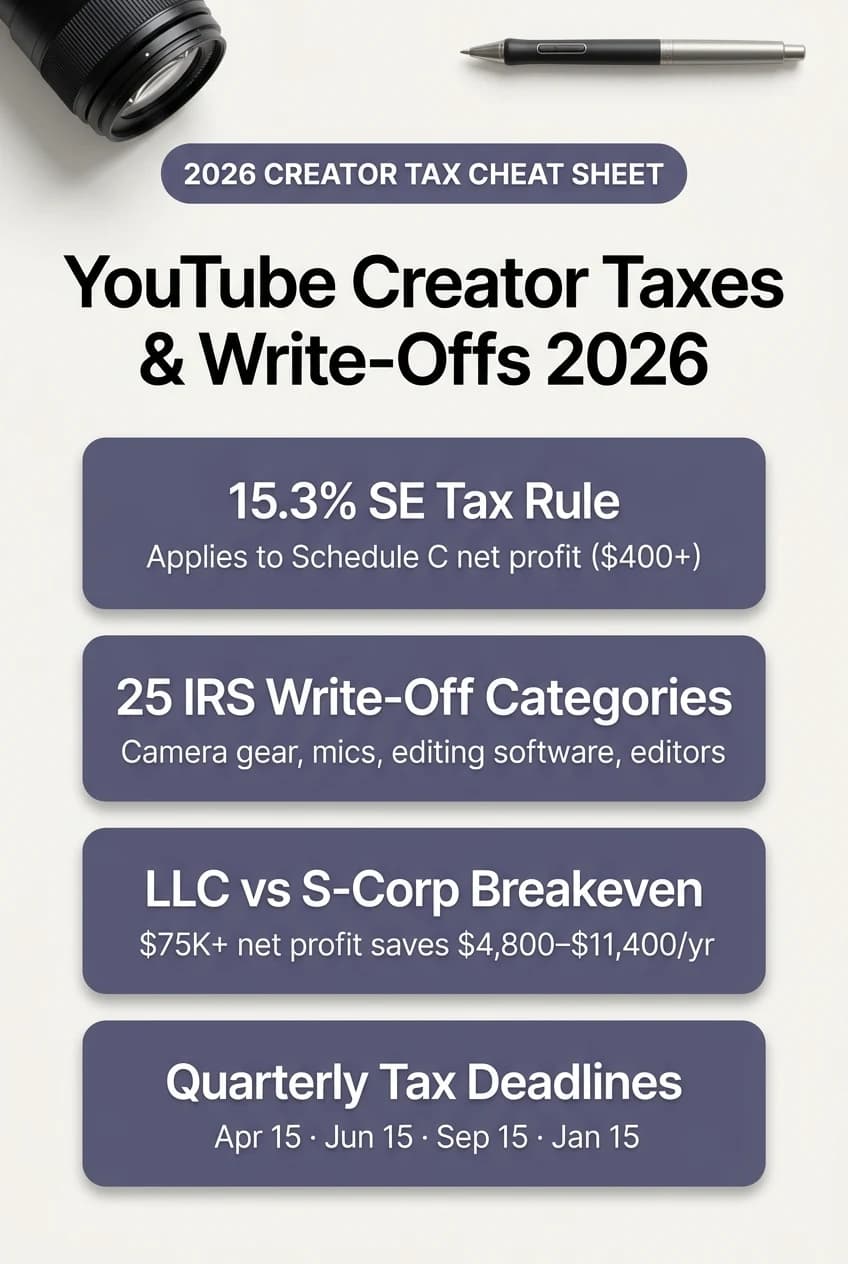
Save This YouTube Creator Tax & Write-Off Blueprint (Pinterest Reference)
Tax rules only save you money if you check them before December 31 and April 15 pass you by. Use the Pin it portrait blueprint right below the article to save our 25 IRS tax write-offs checklist, $75,000 LLC vs. S-Corp breakeven math, and quarterly IRS due dates to your Creator Finance or YouTube Business Pinterest board.
Cite This 2026 Creator Tax Benchmark Study (For Journalists, CPAs & Bloggers)
Finance editors, creator newsletters, and CPA firms are welcome to cite our 2026 S-Corp breakeven benchmarks or link readers directly to our free no-signup tax calculators. Copy either snippet below:
<p>
Data & calculators via
<a href="https://www.youtubetoolshub.com/blog/youtube-creator-taxes-accounting-software-guide">
YouTube Tools Hub (2026 Creator Tax & Accounting Software Guide)
</a>
and free
<a href="https://www.youtubetoolshub.com/tools/youtube-llc-vs-s-corp-tax-savings-calculator">
YouTube LLC vs S-Corp Tax Savings Calculator
</a>.
</p>Source: [YouTube Creator Taxes & Best Accounting Software Guide (2026)](https://www.youtubetoolshub.com/blog/youtube-creator-taxes-accounting-software-guide) · Free tools: [Creator Tax Write-Off Calculator](https://www.youtubetoolshub.com/tools/youtube-tax-deduction-calculator) & [LLC vs S-Corp Calculator](https://www.youtubetoolshub.com/tools/youtube-llc-vs-s-corp-tax-savings-calculator)Free Creator Finance & Tax Tools to Run Today
- YouTube Creator Tax & Write-Off Calculator – Model your camera gear, studio space, software, and contractor expenses across 7 tax jurisdictions to see estimated savings before calling a CPA.
- YouTube LLC vs S-Corp Tax Savings Calculator – Test your net profit against reasonable W-2 salaries, compliance overhead, and state franchise taxes to spot your exact Form 2553 breakeven.
- YouTube AdSense Wire Fee & Banking Calculator – Measure hidden SWIFT bank wire charges and currency spreads on AdSense deposits (and track deductible banking fees cleanly).
- YouTube Earnings Calculator – Forecast gross annual AdSense revenue across 50+ countries before setting quarterly tax targets.
- YouTube Sponsorship Rate Calculator – Price direct brand deals accurately so your net margin comfortably absorbs taxes and production overhead.
- YouTube Channel Valuation Calculator – See how clean, CPA-verified P&L bookkeeping increases exit valuation multiples from 24x to 40x+ monthly net profit.
Internal Guides to Read Next
- How YouTubers Get Paid: Payment Thresholds & Methods (2026) – Understand Google AdSense 21st-of-month timelines, $100 holds, and W-9 / W-8BEN tax interviews.
- YouTube AdSense Payment Schedule 2026 – Exact dates finalized earnings lock and clear your bank account each month.
- How to Start a YouTube Business in 2026 – Turn your channel into a multi-revenue media company structured for long-term profit and scale.
- YouTube Sponsorship Rate Calculator: Brand Deal Pricing Formula – Calculate sponsorship pricing, usage rights, and contract terms that keep profit margins healthy after taxes.
- YouTube Channel Valuation Calculator Guide (2026) – Learn why clean Wave or QuickBooks financials are mandatory when selling a monetized channel on Flippa or Empire Flippers.
- YouTube CPM Rates by Country (2026 Benchmark Study) – Target Tier-1 audiences where higher RPM easily justifies professional accounting systems.
Authoritative External Tax & Legal References
- IRS Self-Employed Individuals Tax Center – Official federal guidelines on Schedule C filing, Form 1040-ES quarterly payments, and the 15.3% SE tax formula.
- IRS Publication 587: Business Use of Your Home – Complete rules defining the exclusive-use test and simplified vs. actual home studio deduction methods.
- IRS Instructions for Form 2553 (Election by a Small Business Corporation) – Official filing windows, shareholder eligibility, and late-election relief procedures for LLC-to-S-Corp elections.
- U.S. Small Business Administration (SBA): Choose a Business Structure – Neutral federal comparison of Sole Proprietorships, LLCs, and S-Corporations.
- GOV.UK HMRC: Set up as a Sole Trader & Self Assessment – Official UK reporting thresholds and allowable business expenses for creators.
- Government of Canada (CRA): Guide T4002 — Self-Employed Business Income (T2125) – Official Canadian creator expense rules and Capital Cost Allowance (CCA) depreciation classes.
Related guides on this topic: YouTube Monetization Guide · YouTube Earnings Calculator · YouTube Sponsorship Rate Calculator · YouTube Channel Valuation Calculator · YouTube Creator Tax & Write-Off Calculator.
Stop losing $95/mo in AdSense wire & FX conversion fees
If you live outside the United States, traditional banks secretly charge a 2.5%–4.5% foreign exchange markup plus flat $15–$30 incoming international SWIFT wire fees on every single YouTube AdSense & brand sponsorship payout.
Save 3%–5% on YouTube AdSense & Brand Sponsor Wire Fees.
Open Wise Account →Disclosure: When you sign up through links on our site, we may earn an affiliate commission at zero additional cost to you.
Topics
Frequently Asked Questions
How much should a YouTuber set aside for taxes in 2026?
Most US creators should set aside 25% to 30% of net profit (income after legitimate business deductions) in a separate tax savings account. Because Google does not withhold payroll taxes on AdSense payouts, you owe both the 15.3% federal self-employment tax and your regular federal and state income tax brackets. Channels netting over $120,000 in high-tax states like California or New York should save closer to 32%–35% unless they have elected S-Corp status.
What tax form does Google AdSense send YouTube creators?
US creators who earn $600 or more in a calendar year receive Form 1099-NEC or Form 1099-MISC from Google LLC by January 31 (available inside AdSense under Payments -> Settings -> Manage Tax Info). Even if you earn $350 and do not receive a 1099 form, the IRS still requires you to report all self-employment earnings once your total net self-employment profit reaches $400 across all freelance and creator gigs.
Can YouTubers write off camera gear, computers, and home office space?
Yes, provided the item is ordinary and necessary for producing videos and you track personal vs. business use honestly. Dedicated cameras, studio microphones, lighting, Adobe or DaVinci software, and freelance editor invoices are generally 100% deductible on IRS Schedule C. Equipment costing over $2,500 can often be expensed in year one under Section 179 or the IRS de minimis safe harbor election. A spare bedroom used exclusively and regularly for filming and editing qualifies for the Home Office deduction (Form 8829 or the $5/sq ft simplified method up to 300 sq ft).
When is the right time for a YouTuber to switch from an LLC to an S-Corp?
The financial breakeven for electing S-Corp status (IRS Form 2553) typically hits around $75,000 to $80,000 in consistent annual net profit. Below $50,000 net profit, the extra $1,800–$2,600 per year for W-2 payroll software (such as Gusto) and a corporate Form 1120-S tax return usually wipes out the FICA savings. At $120,000 net profit with a $54,000 reasonable salary, an S-Corp saves roughly $6,493 per year in net cash after compliance overhead.
What is the best accounting software for YouTube creators?
For channels earning under $30,000 per year, Wave Accounting offers free double-entry bookkeeping and receipt scanning. Between $30,000 and $80,000, QuickBooks Online Simple Start (or Xero for creators with international multi-currency sponsors) makes Schedule C prep effortless for any CPA. Once net profit clears $80,000 and you want an S-Corp, Collective bundles LLC/S-Corp formation, bookkeeping, payroll, and business tax filing into one creator-focused subscription.
Can YouTubers write off clothes, cars, or travel in vlogs?
Almost never for everyday street clothing. Under long-standing US Tax Court precedent (Pevsner v. Commissioner), clothing suitable for normal wear outside filming is a non-deductible personal expense even if you only buy it for videos; only branded merchandise, safety gear, or true theatrical costumes qualify. Travel and lodging are deductible only when the primary purpose of the trip is documented video production, and vehicle deductions require contemporaneous business mileage logs.
How do non-US YouTubers avoid 30% Google AdSense tax withholding?
Non-US creators must submit Form W-8BEN inside Google AdSense Payments Settings to certify foreign residency. Without an approved W-8BEN, Google withholds 24% on worldwide earnings or 30% on US-sourced views. If your country holds a tax treaty with the United States (for example 0% copyright/royalty withholding for the UK and Canada, 5% for Australia, or 15% for India), claiming treaty benefits on Form W-8BEN drops withholding strictly on US-viewer AdSense revenue to that treaty rate.
Advertisement
Free tools for this topic
Apply what you just read with free creator tools — no signup required.