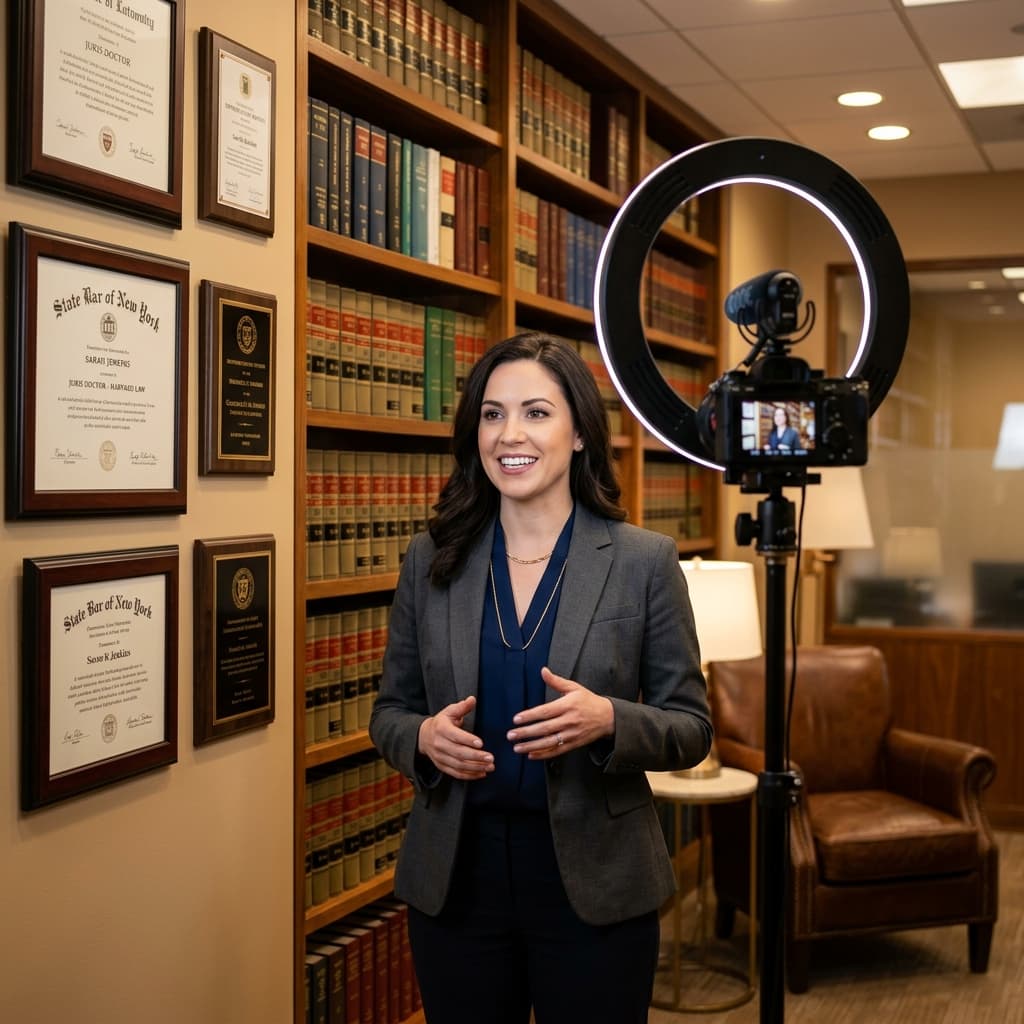
Let me tell you something that most law firm marketing consultants will not say out loud: the attorneys making the most money from YouTube are not the ones with the biggest budgets. They are the ones who show up consistently, speak like a real human being, and answer the exact questions their future clients are already searching for.
I have spent the last three years helping law firms build YouTube channels that generate qualified client leads. Not vanity views — actual phone calls and consultation bookings from people who watched a video, trusted the attorney, and reached out. That shift from "stranger online" to "trusted advisor" happens faster on YouTube than on any other platform. And it costs almost nothing to start.
This is a practical guide to lawyer YouTube marketing in 2026. No fluff. No vague advice. Just the real steps that move the needle for attorneys who want to attract high-value clients through video.
Quick Answer
Lawyer YouTube marketing works by creating educational legal videos that answer the exact questions potential clients search for. A consistent attorney YouTube channel builds trust faster than any ad, drives free organic traffic, and positions you as the go-to expert in your legal niche — leading to more qualified consultations, higher-value cases, and a sustainable referral pipeline.
---
Why YouTube Is the Most Underused Marketing Channel for Lawyers
Think about the last time someone you know needed a lawyer. What did they do first? They Googled it. And increasingly, they also searched YouTube. Phrases like "what happens if I get a DUI in Texas," "how to fight a wrongful termination," or "what does a personal injury lawyer actually do" get hundreds of thousands of searches every single month — and most of those videos have fewer than 5,000 views.
That is an enormous opportunity gap.
Google's own research shows that over 68% of people who hire a professional service provider — doctors, lawyers, financial advisors — watched a video from that provider before making contact. They wanted to hear the person speak. They wanted to see if they trusted them. They wanted to understand the problem before they paid to solve it.
A blog post can explain the law. A YouTube video can make someone feel like they already know you. That emotional connection is what converts a viewer into a consultation request.
Key Takeaways
- YouTube is the second-largest search engine globally, with massive untapped legal queries.
- Video builds trust and emotional connection faster than any written content.
- Attorneys in niche practice areas face almost zero YouTube competition.
- A single evergreen video can generate client inquiries for years.
- YouTube videos also rank on Google Search, doubling your SEO reach.
---
Step 1: Choose the Right Legal Niche for Your Channel
The biggest mistake attorneys make on YouTube is trying to cover too much. "General practice" channels with videos on family law, criminal defense, immigration, contracts, and estate planning all at once confuse the YouTube algorithm and confuse viewers.
You need a content niche. Not because you have to limit your practice, but because YouTube's algorithm needs to understand who your channel is for before it will recommend your videos to the right audience.
Here are some of the highest-performing legal YouTube niches right now based on search volume and commercial intent:
| Practice Area | Avg. Monthly Searches | Competition Level | Client Value |
|---|---|---|---|
| Personal Injury | 2.4M+ | Medium | Very High |
| Immigration Law | 1.8M+ | Medium | High |
| Criminal Defense | 1.2M+ | Low-Medium | High |
| Family Law / Divorce | 1.5M+ | Low | High |
| Employment Law | 890K+ | Very Low | Medium-High |
| Estate Planning / Wills | 670K+ | Very Low | Medium |
| Business / Contract Law | 520K+ | Very Low | High |
Notice something? The practice areas with the lowest YouTube competition — employment law, estate planning, business contracts — often attract the highest-value cases. If you practice in one of these areas, you could become the dominant YouTube voice in your niche within six to twelve months of consistent posting.
---
Step 2: Set Up Your Channel for Credibility and Discovery
Your YouTube channel is a digital office. When a potential client lands on it, they are making a snap judgment about whether you are credible, professional, and worth their time.
Here is what your channel setup needs before you publish a single video:
Channel Name: Use your full name or firm name, not just a keyword. "Smith and Associates Law" is better than "LegalAdviceTips." People hire humans, not brands.
Channel Description: Write two to three clear paragraphs. The first paragraph should state exactly what you do and who you help. The second should explain why they should trust you — credentials, experience, bar memberships. The third should include a call to action with your website or booking link.
Profile Photo: Use a real, professional headshot. Not a logo. Not a generic avatar. Viewers need to see your face before they trust you with their legal problem.
Channel Banner: Include your practice area, location (important for local SEO), and a single clear call to action like "Schedule a Free Consultation."
Trailer Video: Create a 60-90 second channel trailer that answers three questions: Who are you? What kind of videos do you make? Why should a viewer subscribe? Keep it direct and confident.
Once your channel is set up, use the YouTube Tag Generator to build a master list of relevant tags for your legal niche. These tags help YouTube understand your content category and surface your videos to users searching for legal information.
---
Step 3: Create Videos That Answer Real Legal Questions
Here is the core of the entire strategy: your videos should answer the exact questions your potential clients are already searching for.
Do not create marketing videos. Do not talk about your firm's awards or years of experience. Nobody is searching "Smith Law Firm achievements." People are searching their problem — and the attorney who answers that problem on video becomes the trusted advisor by default.

An overhead flat-lay shot of a lawyer's desk showing a content calendar, YouTube Studio analytics on a smartphone, legal notepads and sticky notes with video topic ideas, representing a lawyer YouTube content strategy
*Map out your video topics around the actual questions your clients ask during consultations. Those questions are your content goldmine.*
How to Find Video Topics That Drive Consultations
The best source of video ideas is your own intake process. Think about the last twenty consultation calls you had. What were the first five questions every client asked? Those questions are videos. Every single one.
If you want to go beyond that, use the YouTube Video Ideas Generator to brainstorm content angles for your specific legal niche. You can also use Google's "People Also Ask" boxes, AnswerThePublic, and Reddit's legal subreddits (r/legaladvice has over 2 million members) to find the exact language your potential clients use.
High-converting video formats for legal channels:
- "What happens if you..." videos — These answer the most common fear-based searches. Example: "What Happens If You Get Caught Shoplifting in California?"
- Myth-busting videos — "5 Myths About Personal Injury Claims That Cost People Money." Correcting misconceptions builds immediate authority.
- Process explainers — Walk viewers through exactly what working with you looks like. "What to Expect During Your First DUI Consultation." Removing uncertainty is a massive conversion driver.
- "Do you need a lawyer for..." videos — "Do You Need a Lawyer for a Minor Car Accident?" These attract people at the exact moment of decision.
- State-specific legal guides — "How to File for Divorce in Texas Without a Lawyer" will outrank almost every competitor because it is hyper-specific.
- Case result stories — With client permission, walk through the facts and outcome of a real case. These are extraordinarily persuasive.
---
Step 4: Optimize Every Video for YouTube SEO
Creating the video is only half the work. The other half is making sure YouTube and Google can find it, understand it, and serve it to the right people.
Title Optimization
Your title should contain your primary keyword naturally and create enough curiosity to earn the click. Use the YouTube Title Generator to build high-CTR title variations and test which ones perform best.
A weak title: "Personal Injury Law Overview"
A strong title: "Personal Injury Claim? Here's What Insurance Companies Don't Want You to Know"
Description Optimization
Write a minimum 300-word description. Put your most important keyword and a call to action in the first two sentences. Include your location, practice areas, consultation booking link, and links to related videos. YouTube's algorithm reads descriptions to understand context, and longer descriptions consistently outperform short ones.
Use the YouTube Description Generator to create a structured, keyword-rich description template you can adapt for every video you upload.
Tags and Hashtags
Tags still matter for legal content because they help YouTube cluster your channel with related legal topics. Add 10-15 relevant tags per video — include your primary keyword, location-based variations, and practice-area terms.
Use the YouTube Hashtag Generator to build a hashtag set that increases your video's discoverability in both YouTube search and Shorts feeds.
Thumbnails for Legal Channels
Your thumbnail is the billboard for your video. It needs to communicate trust, authority, and a specific outcome — all within a 1280x720 pixel image that most viewers will see at the size of a postage stamp on mobile.
Best thumbnail practices for attorneys:
- Show your face — Emotion and eye contact in thumbnails dramatically improve click-through rates.
- Use text sparingly — Three to five bold words that reinforce the title, not repeat it verbatim.
- Use a consistent visual style — Same color scheme, font, and layout on every video so your thumbnails are immediately recognizable in a browsing feed.
- Avoid fear-based imagery — Courtroom scenes, handcuffs, and aggressive visuals can trigger YouTube sensitive content filters and reduce distribution.
Download a sample frame from a competitor's high-performing video using our YouTube Thumbnail Downloader to analyze what visual styles work best in your legal niche. Then build your own distinctive version.
---
Step 5: Build Local Authority With Location-Specific Content
YouTube is not just a global platform — it is an incredibly powerful local SEO tool. Google regularly surfaces YouTube videos in local search results, especially for queries like "divorce lawyer near me" or "personal injury attorney Chicago."
Location-specific content should be a cornerstone of your strategy:
- Create city-specific legal guides: "Tenant Rights in Los Angeles: What Your Landlord Can't Do"
- Film videos addressing state laws specifically: "Texas Child Custody Laws Explained Simply"
- Reference local court procedures when relevant: "What Happens at a DMV Hearing in California After a DUI"
This hyper-local approach means you are competing against a much smaller pool of creators. Most national legal YouTube channels avoid location-specific content because it feels too narrow. That is your competitive advantage.
After you publish location-specific content, use the YouTube Channel Audit Tool to track how your videos perform by geography. YouTube Studio Analytics shows you exactly which cities and countries your viewers come from, letting you double down on the local markets driving the most consultation requests.
---
Step 6: Consistency and the 90-Day Trust Window
Here is something I tell every lawyer I work with: YouTube trust is built in 90-day windows.
Viewers do not book consultations after watching one video. They watch three videos. Then they watch five more. Then they subscribe. Then two weeks later, when a legal problem appears in their life, they remember you — not the attorney who ran an ad in the newspaper.
The minimum viable posting schedule for a legal YouTube channel is one video per week. That is 52 videos a year. Within twelve months, a well-optimized legal channel posting consistently will rank for dozens of local and niche legal queries.
If posting weekly feels overwhelming, use the YouTube Content Calendar Generator to plan a full month of content in under 30 minutes. Batch-recording is also extremely effective for attorneys — film four to six videos in a single afternoon, then schedule them to publish weekly.
---
Step 7: Convert YouTube Viewers Into Consultation Calls
Views and subscribers mean nothing if they do not convert into paying clients. Every video you publish needs a clear conversion pathway.
In-video calls to action (spoken):
- At the 30-second mark: "If you are watching this because you are dealing with [situation], the most important thing you can do right now is schedule a consultation. The link is in the description."
- At the end of the video: "If you found this helpful, subscribe for more videos just like this. And if you have a specific question, leave it in the comments — I personally respond to every single one."
Description CTAs:
Put your consultation booking link in the first three lines of every description. Do not make viewers scroll to find how to contact you.
Pinned Comment:
Pin a comment to every video with your firm name, location, and consultation link. This surfaces immediately below the video when viewers scroll down.
End Screen:
Add an end screen with a subscribe button, a link to a related video, and a card linking to your website. End screens keep high-intent viewers engaged after the video ends.
---
Backlink Strategy for Legal YouTube Channels
Building authority for your YouTube channel requires backlinks — links from other reputable websites that point to your channel or individual videos. Here is an actionable backlink strategy specifically for legal channels:
1. Legal Directories and Association Profiles
Your state bar association, Avvo, FindLaw, Justia, Martindale-Hubbell, and Nolo all allow profile links. Update every directory profile to include your YouTube channel URL. These are high-authority legal domains and provide excellent trust signals.
2. Local News Partnerships
Reach out to local news stations and digital publications when a legal story is in the news. Offer to be a legal expert commentator and provide your YouTube channel as a reference. Local news sites typically have strong domain authority and will link to your channel as a resource.
3. Guest Posts on Legal Blogs
Write a short, practical guest article for established legal blogs — Above the Law, The National Law Review, Law360 community sections — and include a reference link to a specific YouTube video as a resource within the article.
4. Community Legal Resources Pages
Many city, county, and nonprofit organizations maintain "community legal resources" pages. Reach out and ask them to add your YouTube channel as a free educational resource for their constituents.
5. Reddit and Legal Forums
When someone asks a complex legal question in r/legaladvice, r/personalfinance, or state-specific subreddits, drop a genuinely helpful response and link to your video as an extended resource. Only link when the video directly answers the question asked.
6. Podcast Appearances
Guesting on legal, business, or entrepreneurship podcasts consistently generates high-quality backlinks. Most podcast hosts publish show notes on their websites with links to guest resources. Mention your YouTube channel during the interview and provide it in your bio.
---
The Revenue Math: Why Legal YouTube Is Worth It
Let us talk numbers. Legal CPM rates on YouTube are among the highest of any niche — typically ranging from $25 to $80 per 1,000 views depending on the practice area and the viewer's country. Personal injury, mass tort, and business law content routinely hits the top end of that range.
But the real money is not in ad revenue — it is in client acquisition cost. A single personal injury case with a $50,000 settlement earns the attorney $16,500 to $20,000 in fees at standard contingency rates. If one YouTube video drives even two new cases per year, the channel has paid for itself many times over.
Use the YouTube Earnings Calculator to estimate the ad revenue your channel could generate as it grows — and then factor in the consultation value on top of that. The combined ROI of a well-run legal YouTube channel is extraordinary.
---
Tools to Accelerate Your Legal YouTube Channel
You do not need to figure out every piece of this alone. Here is the full toolkit for legal content creators:
- YouTube Title Generator — Build search-optimized, high-CTR video titles for every video
- YouTube Description Generator — Create structured, keyword-rich descriptions with proper CTAs
- YouTube Tag Generator — Build comprehensive tag sets for legal content
- YouTube Hashtag Generator — Add the right hashtags to increase video discoverability
- YouTube Thumbnail Downloader — Research competitor thumbnail styles in your legal niche
- YouTube Video Ideas Generator — Generate months of legal content ideas instantly
- YouTube Content Calendar Generator — Plan your posting schedule with a structured calendar
- YouTube Channel Audit Tool — Analyze your channel performance and identify growth opportunities
- YouTube Earnings Calculator — Understand the revenue potential of your growing legal channel
Every one of these is completely free at YouTube Tools Hub — no subscription, no account required.
---
Start Small, Start Honest, Start Now
The attorneys who tell me YouTube is "not for lawyers" are usually the same attorneys who have never posted a single video. The ones who have tried it and stopped after three videos wonder why it did not work immediately.
YouTube rewards patience. It rewards consistency. It rewards attorneys who are willing to answer questions without holding information hostage behind a consultation fee.
The content that performs best on legal YouTube channels is almost embarrassingly simple: a real attorney sitting in front of a camera, speaking plainly, answering the question a scared person typed into a search bar at midnight. That is it. That is the whole strategy.
You do not need a production crew. You do not need a media background. You need to understand the law — which you already do — and be willing to share that knowledge clearly and consistently.
Start this week. Film one video. Post it. Film another next week. Stay consistent for ninety days and watch what happens to your consultation calendar.
*Authoritative External References:*
- ABA Model Rules of Professional Conduct — Always review your state bar guidelines on legal advertising before publishing video content.
- Google E-E-A-T Search Quality Evaluator Guidelines — Understanding Experience, Expertise, Authority, and Trustworthiness helps attorneys create content that ranks in AI and traditional search.
- YouTube Creator Academy — Free official courses on channel growth, SEO, and audience building directly from YouTube.
Topics
❓Frequently Asked Questions
Does YouTube marketing actually work for lawyers?
Yes, YouTube marketing works extremely well for lawyers, particularly for attorneys in niche practice areas with high competition on Google Ads. YouTube is the second-largest search engine globally, and legal queries have enormous search volume. Attorneys who post consistent educational content build trust faster than any ad, attract pre-qualified viewers, and generate consultation requests from people who feel they already know the attorney before ever making contact.
How often should a lawyer post on YouTube?
The minimum effective posting frequency for a legal YouTube channel is one video per week. This gives the algorithm enough content to understand your niche, builds consistent viewer expectations, and compounds into a library of evergreen content over time. Many successful legal channels batch-record four to six videos in a single day and schedule them across the month. Consistency matters more than frequency.
What types of videos do best for lawyer YouTube channels?
The highest-performing legal YouTube content includes: question-and-answer videos addressing common client concerns, myth-busting videos that correct legal misconceptions, process explainers showing what working with an attorney looks like, state-specific legal guides, and case result stories shared with client permission. All of these formats build trust, answer real search queries, and attract viewers at the exact moment they need legal help.
What are the best YouTube tools for lawyer marketing?
The most effective free tools include a YouTube Title Generator for building high-CTR video titles, YouTube Description Generator for keyword-rich descriptions, YouTube Tag Generator for comprehensive tag sets, YouTube Hashtag Generator for improving discoverability, and YouTube Channel Audit tool for analyzing performance data. All available free at YouTube Tools Hub with no account required.
How do lawyers build backlinks for their YouTube channels?
Lawyers build high-quality backlinks by updating legal directory profiles on Avvo, Justia, Martindale-Hubbell, and FindLaw with their channel URL, reaching out to local news outlets for expert commentary, writing guest posts for legal blogs, getting listed on community legal resource pages, and appearing on podcasts where show notes link back to their channel.
How much can a lawyer earn from a YouTube channel?
Legal YouTube channels earn between $25 and $80 per 1,000 views in ad revenue, among the highest CPM rates of any YouTube niche. But the real financial return comes from client acquisition. A single personal injury case closed because of a YouTube video can generate $15,000 to $50,000 or more in legal fees, making YouTube one of the highest-ROI marketing investments for any law firm.