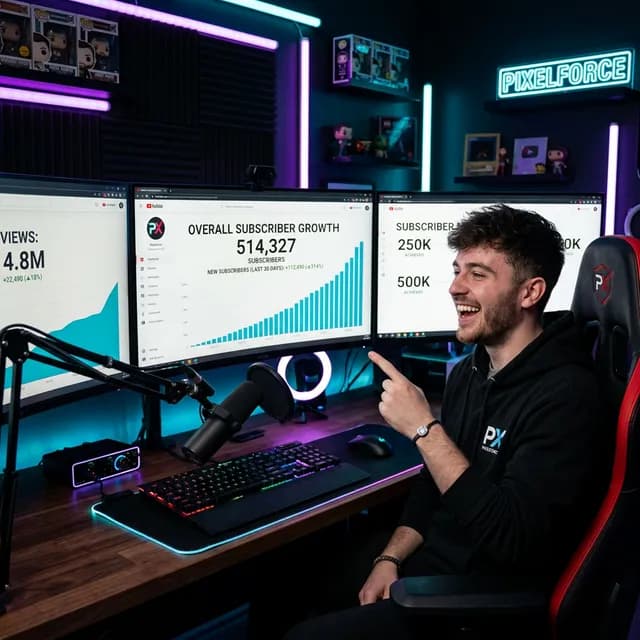
Gaming on YouTube is cutthroat. There are over 40 million gaming channels on the platform right now, and the vast majority of them will never hit 1,000 subscribers. Not because the creators aren't talented. Not because they don't play well. But because they're making the same avoidable strategic mistakes that keep 95% of gaming channels invisible.
I've spent years studying what separates gaming channels that break through from the ones that plateau at a few hundred views per video. The answer almost never comes down to skill at the game itself. It comes down to understanding the YouTube machine—the algorithm, the audience psychology, and the content systems that compound over time.
This is the gaming YouTube growth guide I wish someone had handed me three years ago. Every strategy in here is working right now in 2026.
Important
Quick Answer — How to Grow a Gaming Channel in 2026:
1. Pick a specific audience, not just a game — "casual Minecraft families" beats "Minecraft general"
2. Optimize every thumbnailfor a 6%+ CTR — bad thumbnails kill even great videos
3.Use YouTube Shortsas a daily discovery engine for your long-form content
4.Post on a consistent schedule— 2x/week beats 1x/week almost every single time
5.Optimize your titles and tags with data — not guesswork
Why Most Gaming Channels Fail Before Reaching 1,000 Subscribers
Before the strategies, you need to understand the failure modes. Most gaming channels die in one of four specific ways:
1. "I play everything" syndrome. The YouTube algorithm is a recommendation engine. It needs to know exactly who to show your videos to. If you play Fortnite one week, Call of Duty the next, and then Minecraft the week after, YouTube cannot build a reliable audience profile for your channel. It doesn't know who to recommend you to.
2. Zero thumbnail strategy. Gaming thumbnails are routinely some of the worst-performing thumbnails on the platform. The stereotypical approach of a game screenshot with your gamertag slapped on it is a click-through disaster. The top gaming channels treat their thumbnail like a one-second advertisement.
3. No hook in the first 30 seconds. The average gaming video loses 30-40% of its audience in the first minute. The viewer clicked because your title or thumbnail caught their eye. The moment they click and hear "Hey what's up guys, welcome back to the channel," you've told them nothing new and given them every reason to leave.
4. Ignoring search and SEO entirely.Big channels get discovered mainly through YouTube's recommendation algorithm. But channels under 100K subscribers primarily grow throughYouTube Search. If you're not creating videos with search intent in mind, you're fighting to get discovered by an algorithm that isn't looking for you yet.
Strategy 1: Dominate One Specific Audience Segment
This is the single most important strategic decision you'll make for your gaming channel. And most creators completely skip it.
The gaming niche is not one niche. It's thousands of sub-niches stacked on top of each other. The creators who grow fastest are the ones who can answer this question precisely: "My channel is specifically for [exact audience] who want [specific outcome]."
Here are some examples of going from vague to specific:
| ❌ Too Broad | ✅ Specific and Powerful |
|---|---|
| "Minecraft channel" | "Minecraft survival tips for players who want to beat the game without guides" |
| "FPS gaming" | "Valorant rank-up strategies for Silver players pushing to Platinum" |
| "Retro gaming" | "NES and SNES hidden gem discovery for nostalgic parents who want to share gaming with their kids" |
| "Mobile gaming" | "Free-to-play mobile RPG tier lists and farming guides for players who refuse to spend money" |
Notice how the specific version tells you exactly who the audience is, what they want, and what kind of content you'll be making? This specificity does three powerful things for your YouTube growth strategy:
- The algorithm knows who to show your videos to— Your viewer retention signals come from the right audience, which trains YouTube to systematically find more of them.
2.Your audience feels like the channel is built for them— "This creator gets me" is extraordinarily powerful for building a loyal community.
3.Your content decisions become easier — When you know exactly who you're serving, the next video topic becomes obvious.
Strategy 2: Fix Your Thumbnails — Gaming's Biggest CTR Problem
I'm going to be direct about this: the gaming community has a thumbnail problem. Walk through the YouTube gaming section right now and the vast majority of thumbnails are game screenshots with logos, generic roster cards, or dark atmospheric art that no one can read at thumbnail scale.
The channels breaking through have cracked a different code.
The 4 Elements of a High-CTR Gaming Thumbnail
1. A face showing extreme emotion. This is uncomfortable for many gaming creators to hear, but it's statistically proven. Thumbnails with expressive human faces consistently outperform game-only thumbnails by a significant margin. Shock, excitement, and disbelief are the highest-performing emotions for gaming content.
2. Contrast and visibility at mobile size. Pull out your phone right now and look at your thumbnail at the size it appears on the YouTube home screen. Can you read the text? Can you immediately understand what's happening? If not, it will not get clicked.
3. Three dominant colors maximum. The best-performing gaming thumbnails use one primary color, one contrasting accent, and a neutral dark background. Yellow on black. Cyan on dark. Red on white. Complexity kills click-through rate.
4. Text that adds context, not repeats the title. If your title says "I Finally Beat Elden Ring," your thumbnail text should say something like "TOOK 200 HOURS." The text should create a new piece of information that compounds the curiosity, not echo what they already read.
Use our AI Thumbnail Generator to instantly prototype different visual concepts before you commit to your final design. For text ideas, our Thumbnail Text Generator generates proven psychological hooks specifically built to improve CTR.
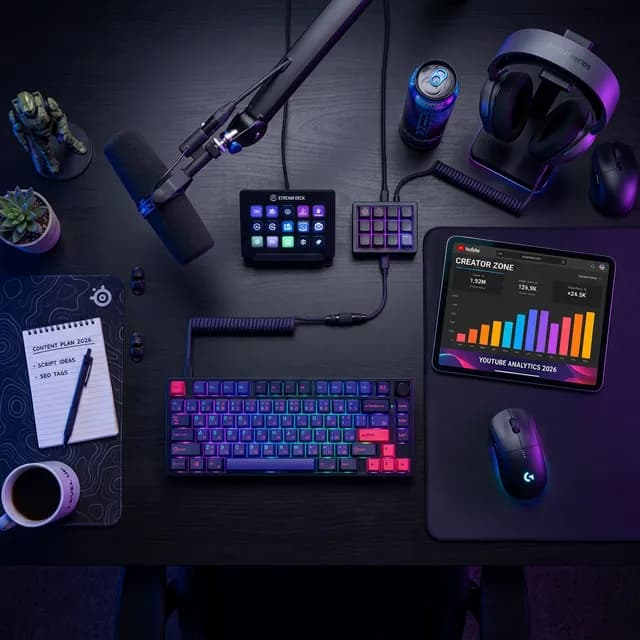
Gaming YouTube Channel Strategy Desk Setup
*A professional content creator setup is more about consistency and strategy than raw hardware — the tools you use to plan and optimize your content matter just as much as your gaming rig.*
Strategy 3: Engineer Your Titles for Both Search and Browse
Your title has two separate jobs in 2026, and you need to optimize for both simultaneously.
Job 1: Get found in YouTube Search. This means including the actual keyword that your target audience types into the search bar. Not a fancy version of it — the exact phrase. If someone searches "how to get more kills in Warzone," your title should contain those words.
Job 2: Get clicked from Browse and Suggested.This means creating emotional pull. Numbers, curiosity gaps, confession formats, and stakes work extremely well for gaming. "I got 100 kills using only a pistol for 24 hours" has stakes. "Every game I die I switch accounts" has consequence.
Title Formulas That Work for Gaming in 2026
-The Challenge:"I played [Game] for [Extreme Duration/Condition] and here's what happened"
-The Ranking:"[Number] [Item/Character/Strategy] Ranked Worst to Best in [Game]"
-The Confession:"I've been doing [Common Thing] wrong for [Time] — here's the fix"
-The Stakes:"If I lose this match, I [Serious Consequence]"
-The Discovery:"The [Game] secret no one talks about"
Use our YouTube Title Generator to rapidly test different title angles for your next video. Paste in your concept and get dozens of variations to choose from — you'll find options you'd never have come up with on your own.
Once you have your title, use our YouTube Tag Generator to build a comprehensive tag set that covers the exact search queries your target audience uses, including common misspellings that competitors are missing.
Strategy 4: Build the Shorts-to-Long-Form Pipeline
YouTube Shorts in the gaming niche are severely underutilized as adiscovery tool for long-form content. Most gaming creators either ignore Shorts entirely or post random short-form clips with no connection to their main channel.
Top-growing gaming channels in 2026 are using Shorts as a systematic funnel. The structure looks like this:
Step 1: Identify the 60-second moment. In every long-form gaming video you make, there is usually one moment that is genuinely shocking, funny, impressive, or controversial. A clutch play. A catastrophic fail. An unexpected discovery. That's your Short.
Step 2: Export with good captions. Vertical gaming content lives and dies by its first 0.5 seconds. A fast cut, an immediately impressive moment, or a shocking text overlay ("I did this accidentally") gives you a fighting chance. Add auto-captions because 80% of Short viewers watch without sound.
Step 3: Pin a comment linking to the full video. This is the step most people miss. "Full [game] video is on my channel" in the first pinned comment converts Short viewers into long-form audience members remarkably well.
Step 4: Build the habit, not the viral moment. Don't post Shorts hoping one goes viral. Post 5-7 Shorts per week as a consistent system for getting your channel in front of new people. The compound effect over three months is substantial. Pair this with our YouTube Description Generator to make sure each Short has optimized metadata.
Strategy 5: Master the First 90 Seconds — Your Retention Weapon
Your audience retention curve in YouTube Analytics tells you exactly where people are leaving. For gaming channels, the most critical zone is the first 90 seconds.
Here's what the winning format looks like:
Seconds 0-10: Start mid-action. Start mid-sentence. Start with the most visually impressive moment. Never start with an intro. The algorithm measures viewer retention from the very first second.
Seconds 10-30: State the stakes or the concept explicitly. "Today I'm attempting to complete GTA 5 without dying — and I've been trying for three weeks." The viewer now has a reason to keep watching.
Seconds 30-60: Give them a preview of the payoff. Show a quick 3-second clip of you reacting to the climax of the video. This is the "open loop" — they now have to see how you get there.
Seconds 60-90:Re-commit them by drilling into the content. No sponsored reads here. No lengthy setup. Get into the actual substance that your thumbnail and title promised.
If your audience retention is dropping below 40% average, there's almost always a problem in this first 90-second window. Fix this before anything else.
Pro Tip
Use YouTube Studio's Audience Retention Heatmap feature. It's built directly into your analytics and shows you the exact second where viewers are leaving. Watch that part of your video and honestly ask: "If I were a new viewer with no context, does this part earn my time?" Usually the answer reveals the problem instantly.
Strategy 6: Use YouTube Search SEO to Build Your Foundation
Here's the honest truth about how algorithm recommendations work for small channels:YouTube doesn't recommend a channel it doesn't trust yet. Before you break 10,000 subscribers, the Browse and Suggested Video features will barely acknowledge your existence.
But YouTube Search works for channels of all sizes on day one.
Someone types "best budget gaming PC build 2026," YouTube shows results — including results from channels with 500 subscribers if those videos are well-optimized. This is the growth engine you need to exploit right now.
How to Find High-Opportunity Gaming Search Keywords
The YouTube search bar autocomplete method: Start typing your video topic into YouTube's search bar and watch what phrases autocomplete. These are real things people are searching for right now. If you type "how to aim better in" and YouTube suggests "how to aim better in Valorant," "how to aim better in Fortnite," and "how to aim better on controller" — those are proven search terms.
The comment mining method: Go to the most popular videos in your niche. Read the comment sections. What questions are people asking that the video didn't answer? Those questions are each a potential video topic with confirmed demand.
The "Also Search For" method: After searching for a term on YouTube, scroll down and look for the "People also search for" chips that appear. These are low-competition related keywords that are currently getting traffic from viewers who aren't fully satisfied with what they found.
According to Backlinko's YouTube ranking factors study, videos with high view velocity in the first 24-48 hours after publishing rank significantly higher in search results. This is why having a base audience from Shorts (Strategy 4) and a consistent upload schedule (Strategy 7) compounds directly with your SEO efforts.
Strategy 7: Build an Audience, Not Just View Counts
The gaming channels that survive algorithm changes, game trends dying, and platform fluctuations are the ones that built genuine communities. View counts are a vanity metric. Community is an asset.
Here are the specific tactics that build gaming communities in 2026:
1. End every video with a genuine question. Not "Let me know in the comments below." A specific, answerable question. "What was your most embarrassing gaming fail this week?" invites a story. "What did you think of the video?" invites nothing.
2. Pin your own comment as a community update. The pinned comment on a gaming video is prime real estate. Use it to add extra context, post a quick update, or ask a follow-up question. Creators who actively pin their own comments see significantly higher comment counts.
3. Reply to every comment in the first 48 hours. When your channel is under 50K subscribers, this is completely doable and it signals to YouTube that your content generates active engagement — not just passive viewing.
4. Create content that references previous content. "Last week I said X, and 247 of you disagreed — so today I'm testing it." This rewards loyal viewers and creates a reason to subscribe rather than just watch the one video.
Strategy 8: Optimize Your Upload Timing for Maximum Push
The first 48 hours of a video's life are mathematically the most important. YouTube tests your video with a small sample of your subscribers and evaluates the CTR and watch time. If those numbers are strong, it expands reach. If not, the video gets buried.
Publishing at the wrong time means fewer subscribers see the notification, which means fewer early signals, which means a smaller push.
According to our Best Time to Upload on YouTube guide, gaming audiences peak at specific windows that differ significantly from other niches:
| Platform/Region | Best Upload Window | Peak Days |
|---|---|---|
| US Gaming Audience | 4 PM – 7 PM EST | Friday, Saturday, Sunday |
| UK Gaming Audience | 4 PM – 8 PM GMT | Saturday, Sunday |
| Global Gaming | 3 PM EST Friday | Friday |
Gaming is heavily tied to weekend consumption. Viewers who play games on weekends are also watching gaming YouTube content on weekends. Publish by Friday afternoon to capture the weekend wave.
Strategy 9: Monetization and Channel Revenue in the Gaming Niche
Gaming has a reputation for lower CPMs than finance or tech channels. That reputation is partially earned. The average Gaming content CPM typically runs between $2–$5 for broad gaming content. However, there are clear strategies to push that significantly higher:
1. Target higher-value sub-niches. PC Building, Gaming Peripherals Reviews, Sim Racing, and Flight Simulation content consistently commands $8-$18 CPM because the advertisers targeting those viewers (GPU manufacturers, peripheral brands, simulator software companies) are spending significantly more per click.
2. Build a membership tier. The YouTube Membership feature is dramatically underused in the gaming community. Offering exclusive early access, gameplay sessions with the creator, or a private Discord server at $4.99-$9.99 per month directly from YouTube creates entirely platform-independent revenue.
3. Sponsor discovery. Gaming channels over 20K subscribers are actively sought by peripheral brands, VPN companies, gaming chair makers, and energy drink brands. Use our YouTube Earnings Calculator to model your current earnings and project what revenue looks like at your target subscriber count and CPM range.
4. Affiliate programs.Add affiliate links for every piece of equipment you use. Amazon Associates for gaming peripherals, Fanatical or Humble Bundle for game codes, and CJS-CDKeys for software work well. Even small channels can generate meaningful affiliate revenue if their audience trusts them.
The Compound Effect: Putting it All Together
Here's what the math looks like for a gaming channel that implements all of these strategies correctly:
- You post2 long-form videos per week(one search-optimized, one entertainment/showcase)
- You post5-7 Shorts per weekfrom those long-form videos
- Every video has aproperly optimized title and thumbnailwith a 6%+ CTR goal
- Youengage in every comment sectionfor 48 hours post-upload
- You reviewanalytics every Monday and double down on what's working
Following this system for 6 consistent months will produce results that feel disproportionate to your effort level. Not because of luck, but because of compounding. Each video that gains traction makes the next video more likely to perform. Each subscriber from Shorts becomes a long-form viewer. Each long-form viewer becomes a comment. Each comment trains the algorithm.
The fastest-growing gaming channels in 2026 don't have better PCs, better editing, or more charisma than everyone else. They have better systems.
Quick FAQ — Common Gaming Channel Questions
Gaming YouTube growth is a marathon, not a sprint. The creators who build channels that last understand the difference between tactics (what to do) and strategy (why and when to do it). The eight strategies in this guide cover both sides.
Start with your niche specificity. Then fix your thumbnails. Then build the Shorts-to-Long-Form pipeline. Execute those three things consistently for 90 days and your analytics will look unrecognizable compared to today.
External resources that validate these strategies:
- TubeFilter Gaming Creator Revenue Reports for current monetization benchmarks
- Social Blade YouTube Statistics for benchmarking your channel's growth trajectory against comparable channels
- YouTube Creator Academy for platform-official guidance on the algorithm's current priorities
Topics
❓Frequently Asked Questions
How long does it take to grow a gaming YouTube channel?
With a consistent strategy (2 videos per week, optimized thumbnails and titles, and active Shorts posting), most gaming channels reach 1,000 subscribers within 6-12 months. The critical variable is niche specificity — channels targeting a specific audience type grow 2-3x faster than 'general gaming' channels.
Is gaming still a good YouTube niche in 2026?
Yes, gaming remains one of YouTube's largest and most engaged niches with billions of monthly views. It is competitive, but specific sub-niches like mobile gaming guides, PC build tutorials, and rank-up coaching content continue to show strong growth even for new channels.
How many views does a gaming YouTuber need to make money?
To join the YouTube Partner Program, you need 1,000 subscribers and 4,000 watch hours. At that point, with an average gaming CPM of $2-$5, you'd earn roughly $2-$5 per 1,000 views. Channels targeting higher-CPM sub-niches like PC hardware or sim-racing can earn $8-$18 per 1,000 views.
What is the best upload frequency for gaming channels?
Two long-form videos per week is the sweet spot for most growing gaming channels. Combine this with 5-7 YouTube Shorts per week repurposed from your long-form content. Quality matters more than quantity for long-form, but for Shorts, consistent daily posting compounds noticeably over time.
Do gaming channels need face cam to grow?
No, but it helps. Faceless gaming channels can grow successfully, especially in tutorial, speedrun, and game analysis formats. However, channels with authentic on-camera personality typically build stronger communities and higher engagement rates, which signals better to the algorithm.
What gaming content gets the most YouTube views in 2026?
The highest-performing gaming content formats in 2026 are: challenge videos (especially with real stakes), tier list and ranking videos, 'I spent 100 hours' type deep dives, multiplayer moments and reaction content, and first-impressions reviews of newly released games timed to the game's launch traffic spike.
Free tools for this topic
Apply what you just read with free creator tools — no signup required.