
If you've spent any real time posting short videos, you've probably wondered — why does the same clip perform completely differently depending on where you post it? And more importantly, why does your bank account look so different depending on which platform you're actually monetized on?
Short-form video is supposed to be the great equalizer. Post a 60-second clip, go viral, get paid. That's the promise. But the reality of monetization across YouTube Shorts, TikTok, and Instagram Reels in 2026 is far more nuanced — and the gaps between platforms are genuinely eye-opening once you dig into the actual numbers.
I've spent time mapping out exactly how each platform's creator monetization programs work, what the real payout rates look like, and which platform gives creators the most sustainable income path. This isn't a hype piece for any single platform. These are the numbers as they actually stand right now.
Important
Quick Answer — Which Platform Pays Most in 2026:
1. YouTube Shorts pays the most *on average* — RPMs range from $0.03–$0.07 per view, but sharing real ad revenue makes it more sustainable
2. TikTokpays the least per view — the Creator Rewards Program averages $0.02–$0.04 per 1,000 views for most creators
3.Instagram Reelsruns a bonus-based program with inconsistent payouts — many creators receive $0 while others earn hundreds per month
4.The platform that pays most depends on your niche, audience geography, and content type — it's not one-size-fits-all
5. Diversifying across all threewhile building your YouTube long-form presence is the smartest financial strategy
The Three Monetization Models — How Each Platform Actually Pays
Before we can compare dollar amounts, you have to understand that each platform runs a completely different monetization architecture. Comparing TikTok to YouTube Shorts without understanding the structure is like comparing salary to hourly wage without context.
How YouTube Shorts Monetization Works
YouTube Shorts flipped its monetization model in early 2023 and it hasn't looked back since. Instead of the old Shorts Fund (which was essentially an arbitrary bonus pool with zero transparency), YouTube now runs Shorts through theYouTube Partner Program using real ad revenue sharing.
Here's how it actually works:
Step 1 — Ads run between Shorts in the feed. Advertisers pay to show ads between Shorts in the YouTube Shorts feed, just like ads appear between regular videos.
Step 2 — Revenue goes into a creator pool. YouTube takes 55% of that ad revenue (as always) and pools the remaining 45% across all Shorts creators based on how many views they drove relative to the total Shorts feed views that period.
Step 3 — Music deductions apply. If your Short uses licensed music, a portion of your revenue share goes to the music rights holder. Original audio keeps the full share.
What the numbers actually look like:
Most Shorts creators report RPMs (revenue per 1,000 views) between $0.03 and $0.07, meaning 1 million views on YouTube Shorts might earn you between $30 and $70. That sounds low — and it is lower than long-form YouTube. But it's still real ad revenue with a transparent calculation behind it, which is more than either competitor can honestly claim.
Creators in high-CPM niches like personal finance, tech, and business tend to earn at the higher end of that range because the ad market around their Shorts content commands higher rates. Use our YouTube Earnings Calculator to model what your specific niche and view count might generate on Shorts versus long-form.
How TikTok Pays Creators
TikTok killed its original Creator Fund in late 2023 and replaced it with the Creator Rewards Program— a name change that came with some structural improvements, though the payouts remain the underwhelming part.
The Creator Rewards Program uses a formula that factors in:
-Video views(must be over 1 minute to qualify for higher rates)
-Audience quality(Tier 1 geography — US, UK, AU, CA pays more)
-Content authenticity(TikTok's algorithm penalizes repurposed or duplicate content)
-Engagement rate (saves, shares, and comments matter more than likes)
What the numbers actually look like:
The most honest data from TikTok creators in 2026 puts average payouts at $0.02–$0.04 per 1,000 views— and that's for videos over one minute long. Shorter clips earn substantially less or nothing at all from the program directly.
For context, a video with 1 million views on TikTok might earn between $20 and $40 from the Creator Rewards Program. Some creators in very high-engagement niches report slightly better rates, but $0.05 per 1,000 views is reported as a ceiling by most creators in the program.
There's also a significant geography problem: TikTok pays dramatically less for views from Tier 2 and Tier 3 countries. If your audience is concentrated outside the US, UK, Canada, and Australia, your effective payout rate drops considerably below even those averages.
How Instagram Reels Monetization Works
Instagram (owned by Meta) has approached creator monetization through Reels with the most confusing and inconsistent system of the three. TheReels Play Bonusprogram — which offered eligible creators bonuses based on view milestones — has been quietly winding down since late 2024.
As of early 2026, Instagram's creator monetization is invitation-only and structured around:
-Performance bonuses— Eligibility and payout amounts are set monthly, completely at Meta's discretion
-Brand partnership tools— Meta's Creator Marketplace for negotiating brand deals
-Shopping and affiliate income— Through Meta's commerce ecosystem
The honest reality for most Reels creators:direct monetization from Instagram for short-form video views is minimal to nonexistent for the vast majority of creators.Unless you're in Meta's selective bonus program, Reels views don't directly translate to deposits in your account the way YouTube Shorts does.
Where Reels does generate income for creators is throughbrand partnershipsfacilitated by the platform's reach, andcross-pollinationwith Facebook content where ad revenue sharing exists.
Side-by-Side Comparison: What 1 Million Views Is Worth
Let's cut to the number everyone actually wants to know. Here's what 1 million views typically earns across all three platforms in 2026, assuming moderate audience quality (mix of Tier 1 and Tier 2 geography):
| Platform | Est. Earnings per 1M Views | Payment Model | Consistency |
|---|---|---|---|
| YouTube Shorts | $30–$70 | Ad revenue share | High — predictable monthly |
| TikTok | $20–$40 | Creator Rewards Program | Moderate — varies monthly |
| Instagram Reels | $0–$35 | Invitation-only bonus | Low — inconsistent or zero |
A few important caveats buried in that table:
YouTube wins on consistency. Once you're in the YPP and making Shorts, you know roughly what your views are worth. The payment schedule is reliable and transparent.
TikTok can outperform YouTube if your content skews toward US audiences. Pure Tier 1 traffic on TikTok's Creator Rewards Program pushes payouts toward $0.04–$0.05 per 1,000 views, which can occasionally match YouTube Shorts RPMs for that same content.
Instagram Reels is currently the weakest direct payer but remains the strongest for brand deal discovery. If your goal is attracting sponsorships rather than platform payments, Reels' reach on a highly engaged platform makes it valuable as a top-of-funnel.
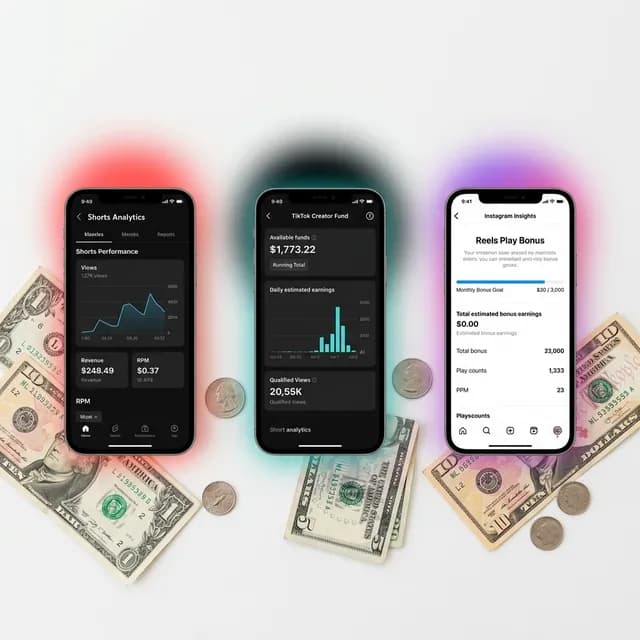
Three smartphones showing YouTube Shorts, TikTok, and Instagram Reels analytics dashboards with dollar coins scattered around them on a white desk
*The actual earnings gap between YouTube Shorts, TikTok, and Instagram Reels becomes most visible when you compare what 1 million views generates on each platform side by side.*
The Requirements: What It Takes to Get Paid on Each Platform
Earnings per view matter — but you can't earn anything until you meet each platform's monetization threshold. Here's where the requirements stack up:
YouTube Shorts Monetization Requirements (2026)
To earn from YouTube Shorts, you need to join the YouTube Partner Program, which requires:
- 500 subscribersminimum (lowered threshold for basic access)
-3,000 watch hourson long-form videos in the past 12 months, OR
-3 million YouTube Shorts viewsin the past 90 days
-No active community guideline strikes
The dual-path requirement is both the challenge and opportunity here. You can qualify purely through Shorts view counts (3 million in 90 days) or through the traditional long-form watch hours path. Channels that post both long-form and Shorts content can hit the threshold faster than either path alone.
Our guide to YouTube Shorts monetization covers the complete step-by-step YPP application process, what happens after you apply, and what to expect in the review period.
TikTok Creator Rewards Requirements
- 10,000 followersminimum
-100,000 video viewsin the past 30 days
- Account must be in good standing and in an eligible country
- Videos must beat least 1 minuteto maximally qualify
The 10,000 follower requirement is TikTok's real gatekeeper. Building to that threshold without monetization can be genuinely demotivating, especially for creators who are already generating millions of views.
Instagram Reels Monetization Requirements
-No publicly disclosed universal threshold— the bonus program is invitation-only
- Meta selects eligible creators based on follower count, content type, and engagement history
- Generally, creators with10,000+ followersand consistent high-view content are more likely to receive invitations
The opacity here is Instagram's biggest problem for creators trying to plan around it. There's no application process and no guaranteed threshold to hit.
Which Platform Actually Builds the Most Sustainable Income?
This is the more important question — and the answer isn't simply "which pays most per view."
YouTube's Long-Term Flywheel Advantage
YouTube Shorts has something TikTok and Instagram Reels fundamentally cannot offer:it feeds long-form content monetization.
Every Short you post on YouTube has the potential to bring viewers to your full-length videos — which monetize at dramatically higher RPMs ($2–$25+ per 1,000 views depending on niche). A Short that earns $40 for a million views might also drive 50,000 watch hours of long-form content that generates $500–$2,000 in additional revenue.
This flywheel doesn't exist on TikTok or Instagram in anywhere near the same way. Both platforms are designed to keep users inside their own ecosystem, not send them to your external content.
Pro Tip
Build your short-form content strategy as a funnel, not a destination.Use Shorts to get discovered, then convert those viewers to long-form watch time. The combination of Shorts + long-form on YouTube creates a revenue engine that neither TikTok nor Instagram alone can replicate. Optimize your long-form videos with our YouTube Tag Generator to make sure new viewers from Shorts can find your best content easily.
TikTok's Discovery Ceiling Problem
TikTok's algorithm is genuinely extraordinary at getting your content in front of new people. The For You Page reach on a new account is unmatched. But that discovery power doesn't translate into sustainable income the way YouTube's system does.
The Creator Rewards Program has shown consistent signs of payout reduction as TikTok's creator base has grown. More creators competing for the same pool means lower per-view rates over time. Creators who were earning $100/million views in 2022 are reporting $20-40/million views in 2026 — a more than 50% effective pay cut without any announcement.
Instagram Reels as a Brand Deal Pipeline
If your content targets lifestyle, fashion, fitness, beauty, food, or parenting — Instagram Reels may generate more money for you than either YouTube Shorts or TikTok throughbrand partnerships, not direct payouts.
A Reels creator with 50,000 highly engaged followers in the fitness space can command $500–$2,000 per sponsored post from supplement brands, workout app companies, or fitness gear manufacturers. That single brand deal likely exceeds what three months of TikTok Creator Rewards payouts would generate.
The math shifts entirely when you factor in sponsorships — and Instagram's audience demographics skew toward the 25-45 age range that many brands pay premium prices to reach.
The Geographic Factor: Where You Live Changes Everything
Here's a variable most "platform comparison" articles completely ignore: where your audience lives changes the payout calculations dramatically.
| Audience Geography | YouTube Shorts RPM | TikTok Creator Rewards |
|---|---|---|
| USA | $0.05–$0.09 | $0.03–$0.05 per 1K |
| UK / AU / CA | $0.04–$0.07 | $0.02–$0.04 per 1K |
| Germany / France | $0.03–$0.06 | $0.01–$0.03 per 1K |
| India / SEA | $0.01–$0.03 | $0.005–$0.01 per 1K |
| Latin America | $0.01–$0.025 | $0.005–$0.015 per 1K |
If your content naturally attracts US, UK, Canadian, and Australian viewers — YouTube Shorts RPMs compound significantly. Finance creators, tech reviewers, and English-language education channels often find YouTube Shorts earning 3-4x more per view than the platform average because their audience is almost entirely Tier 1.
If your audience is primarily from South or Southeast Asia, Latin America, or parts of Africa — the payout differences between platforms narrow considerably, and the discovery benefits of TikTok may outweigh the marginal RPM differences.
For a deeper dive on how geography affects monetization across all of YouTube, our CPM rates by country guide breaks down exactly which regions drive premium ad rates and why.
The Content Type Factor: What Short-Form Content Actually Works on Each Platform
Monetization rates matter — but you can't earn from an empty account. Each platform's algorithm favors different content styles, which means your content strategy needs to match the platform to generate the view volume that makes monetization worthwhile.
YouTube Shorts thrives on:
- Educational snippets and how-to content ("How to do X in 60 seconds")
- Highlights and teasers from longer YouTube videos
- Behind-the-scenes creator content
- Topic-specific tutorials that connect to a channel niche
- Comment response and community engagement content
TikTok thrives on:
- Trending audio and remix culture
- Highly entertaining, personality-driven content
- Storytelling with emotional arcs
- Content that taps into existing TikTok trends or communities
- Humor, reaction content, and skits
Instagram Reels thrives on:
- High-production value lifestyle and aesthetic content
- Content connected to existing Instagram audiences (fashion, food, fitness)
- Collaborative content with other creators
- Branded content with polished visual identity
- Content that fits seamlessly into the Instagram visual feed aesthetic
The clearest takeaway: if you're building a YouTube channel and want to use short-form as a growth engine, YouTube Shorts gives you both the best content synergy (clips from your own channel) and the most sustainable revenue. If you're a personality-first creator focused purely on entertainment, TikTok's discovery algorithm is still unmatched for raw reach. If you're in a visual lifestyle niche and brand deals are your primary income goal, Reels is a serious commercial tool.
How to Maximize Earnings Across All Three Platforms
Most creators eventually figure out the most practical answer: post on all three, but build your foundation on YouTube.
Here's a content repurposing system that works:
1. Create your hero piece on YouTube — a 10-20 minute long-form video optimized with the right tags, title, and description. Use our YouTube Title Generator and YouTube Description Generator to maximize its search visibility from day one.
2. Cut three Shorts from that video — the hook moment, the most surprising fact or point, and the conclusion/call to action. Post all three as YouTube Shorts within the same week as the long-form video.
3. Post those same clips to TikTok and Reels — with format adjustments (TikTok sometimes requires different audio treatment; Reels benefits from higher production polish). This costs you almost nothing extra after the YouTube clips are cut.
4. Drive everything back to YouTube— In your TikTok and Reels descriptions (and pinned comments), direct viewers to "the full breakdown on my YouTube channel." This cross-platform funnel converts discovery from TikTok and Instagram into long-form watch time on YouTube, which earns at dramatically higher rates.
This system means you're earning from YouTube Shorts RPM, TikTok Creator Rewards, and Reels bonuses or brand deals simultaneously — while every view from TikTok and Instagram that converts to YouTube is also generating long-form ad revenue.
Note
On Comparing "Views" Across Platforms: View counting definitions differ significantly. YouTube counts a view after 30 seconds of watch time (for long-form) or after the full Short is watched for Shorts. TikTok counts a view almost immediately. Instagram Reels counts a view after 3 seconds. This means the same piece of content may show wildly different "view counts" depending on where it's posted — but the TikTok number inflates the fastest due to the shortest view threshold.
The Bottom Line: Where Should You Focus in 2026?
Here's my honest recommendation based on everything we've covered:
If you already have a YouTube channel: Lean into YouTube Shorts as your primary short-form platform. The revenue is the most transparent and sustainable. More importantly, Shorts compound your existing channel growth in a way that TikTok and Instagram cannot match.
If you're starting from zero with no YouTube presence: TikTok's discovery algorithm is the fastest way to find what content resonates with an audience. Build there first, validate your content, then move that momentum to YouTube where the monetization model rewards loyalty and depth.
If you're in a high-visual, lifestyle-forward niche: Instagram Reels deserves serious investment — not for the direct payouts, but as a brand partnership pipeline. The ROI on a single well-placed brand deal can dwarf three months of either TikTok or YouTube Shorts revenue.
If your goal is maximum total income:You need all three, with YouTube as your income core. The creators pulling $5,000–$20,000/month from short-form content are almost universally running a multi-platform strategy with YouTube long-form as the primary revenue driver. Our YouTube Shorts Viral Strategy guide covers the content system that drives compound growth when you commit to the platform seriously.
Whatever strategy you choose, use our YouTube Earnings Calculator to model your realistic income projections at different view volumes, CPMs, and platform mixes.
External References and Verified Data Sources
These statistics represent a snapshot of platform policies as of early 2026, which are subject to change. For the most up-to-date information, consult the official sources below:
-YouTube Partner Program Official Requirements— YouTube's official eligibility criteria and revenue share documentation
-TikTok Creator Rewards Program Policy— TikTok's official creator monetization guidelines and eligibility documentation
-Meta Creator Monetization Policies— Instagram and Facebook's official creator monetization terms
-Influencer Marketing Hub — Creator Earnings Report 2026 — Independent analysis of cross-platform creator earnings data
Related guides on this topic: YouTube Shorts Monetization 2026 · Shorts Script Planner · Shorts Ideas 2026 · Shorts Viral Strategy · Hashtag Generator.
Topics
❓Frequently Asked Questions
Does YouTube Shorts pay more than TikTok?
In most cases, yes. YouTube Shorts pays through actual ad revenue sharing (part of the YouTube Partner Program), with RPMs typically ranging from $0.03–$0.07 per view. TikTok's Creator Rewards Program currently averages $0.02–$0.04 per 1,000 views. Beyond the direct payout difference, YouTube Shorts also drives traffic to long-form YouTube videos that earn at much higher RPMs, making the total value of a YouTube Short significantly higher over time than TikTok views at equivalent counts.
How much does TikTok pay per 1,000 views in 2026?
TikTok's Creator Rewards Program pays approximately $0.02–$0.04 per 1,000 views in 2026 for most creators, meaning 1 million views earns roughly $20–$40. Payouts are higher for videos over one minute, for creators with predominantly Tier 1 audiences (US, UK, CA, AU), and for original content with strong engagement signals like saves and shares. Repurposed or duplicate content is penalized under the current Creator Rewards formula.
How many views do you need on YouTube Shorts to make money?
To join the YouTube Partner Program through the Shorts path, you need 3 million YouTube Shorts views within the past 90 days (or 3,000 watch hours on long-form videos in 12 months combined with 500 subscribers). Once in the YPP, you earn from every Shorts view through ad revenue sharing. Most active Shorts creators report needing consistently 500K–1M+ views per month to see meaningful direct earnings from Shorts alone.
Is Instagram Reels worth it for making money?
Instagram Reels is worth it primarily as a brand deal pipeline, not for direct platform payments. Meta's Reels Play Bonus program has been scaling back, and direct per-view earnings are minimal to nonexistent for most creators. However, high-engagement Reels in lifestyle, fitness, food, and fashion niches are extremely valuable for attracting paid brand partnerships — often generating more per sponsored post than months of TikTok or YouTube Shorts direct revenue.
Can I cross-post the same video to YouTube Shorts, TikTok, and Reels?
Yes, and most successful creators do exactly this. However, there are platform-specific considerations: YouTube penalizes Shorts that have TikTok watermarks in the video (so export a clean version). TikTok's algorithm detects and reduces reach on content that appears to be repurposed from other platforms. Instagram Reels generally accepts cross-posted content but rewards content that feels native to its aesthetic. Strip platform watermarks, adjust captions per platform, and post slightly different hooks for each. The extra 15 minutes per week is worth the additional reach.
Which short-form video platform is best for beginners?
TikTok gives beginners the fastest organic discovery through its For You Page algorithm, which can push videos from brand-new accounts to thousands of viewers immediately. However, YouTube Shorts is the better long-term starting platform if you're building toward a YouTube channel and want to work toward the YouTube Partner Program. For creators with no audience who want to find what content works quickly, starting on TikTok to test content, then mirroring proven content to YouTube Shorts, is a practical approach.
What type of short-form content earns the most money?
On YouTube Shorts, finance, tech, business, and SaaS-focused content earns the highest RPMs because the ad market for those audiences is premium — similar to how long-form YouTube content in those niches commands $8–$25 CPMs. On TikTok, content with strong Tier 1 audience concentration and videos over one minute earn the most from the Creator Rewards Program. Overall, educational content that attracts US/UK professionals and business owners generates the highest revenue per view across all three platforms.
Free tools for this topic
Apply what you just read with free creator tools — no signup required.