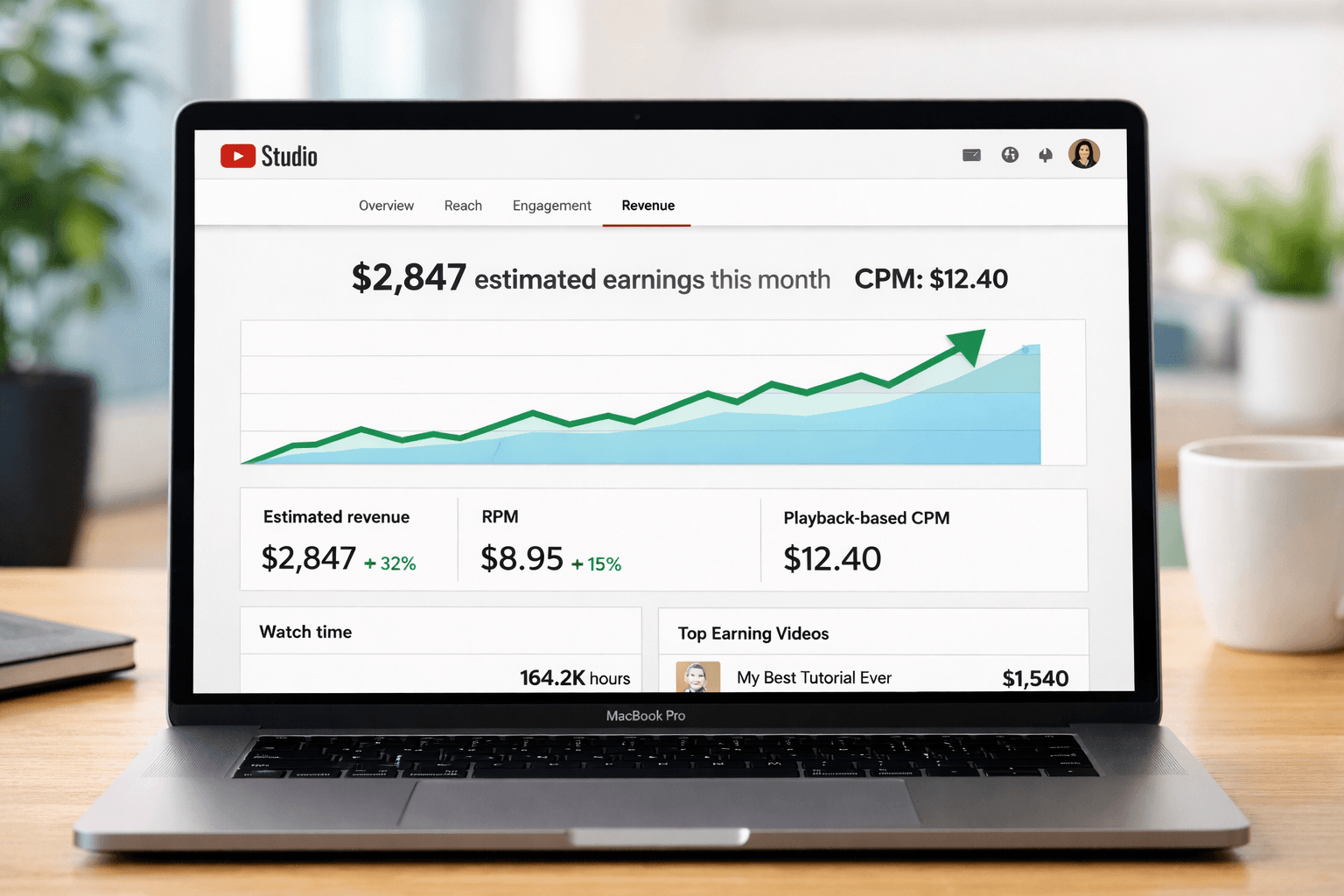
Three months after hitting monetization, I checked my YouTube Studio dashboard expecting to see...honestly, I don't know what I expected. Maybe a few hundred bucks?
The number was $47.23 .
I'd spent six months grinding to reach 1,000 subscribers and 4,000 watch hours. Six months of filming, editing, uploading, optimizing.
And my reward was enough money for a * nice dinner *.
But here's the thing—that disappointment taught me more about YouTube monetization than any tutorial ever could.
Two years later, that same channel brings in $3, 200 / month.
Not life - changing, but enough to quit my part - time job and go full - time on content.
What changed ? I stopped believing the hype and started understanding how the system * actually * works.
The Truth About YouTube Monetization(That Nobody Mentions)
Let me get this out of the way: most creators fail at monetization not because they can't reach the requirements. They fail because they fundamentally misunderstand what YouTube monetization actually is.
Note
It's not passive income. It's not "upload and earn." It's a business model that rewards specific viewer behavior—and if you don't understand that behavior, you won't make money.
Here's what I mean.
What YouTube Actually Pays You For
YouTube doesn't pay you for views. I know, I know—everyone calls it "pay per view," but that's misleading.
YouTube pays you when:
- Someone watches an ad on your video
- That person doesn't skip the ad (for skippable ads)
- The advertiser pays YouTube for that impression
- YouTube gives you 55 % of what they received
Notice what's missing? The view itself doesn't matter.
What matters is whether advertisers want to show ads to your viewers.
This is why two channels with identical view counts can have wildly different earnings.
Real CPM Data From My Channels(And What It Means)
CPM stands for "cost per mille"—basically, how much advertisers pay per 1,000 ad impressions.Your RPM (revenue per mille) is what you * actually * earn after YouTube takes their cut.
Here's what I've seen across different channels I run or consult for:
Tech Reviews Channel(USA)
* CPM: $12 - 15
* RPM: $6 - 8
* Why it's high: Tech buyers have money to spend, advertisers pay premium rates.
Gaming Commentary(Mixed Audience)
* CPM: $3 - 5
* RPM: $1.50 - 2.50
* Why it's low: Younger audience, less purchasing power, saturated niche.
Finance Education(USA / UK / Canada)
* CPM: $18 - 25
* RPM: $10 - 14
* Why it's absurd: Financial services companies pay insane rates for leads.

CPM Rates Comparison
The pattern ? Advertisers pay more when your audience can afford to buy what they're selling.
YouTube Partner Program Requirements(2026 Update)
You probably know the basics, but let's make sure because YouTube's changed these a few times:
Standard Requirements:
* 1,000 subscribers
* 4,000 valid watch hours in the past 12 months
* OR 10 million valid Shorts views in the past 90 days
* Follow YouTube's monetization policies
* Live in an eligible country
* Have 2 - step verification on your Google Account
* Link an AdSense account
What "valid" watch hours actually means:
Not every view counts toward your 4,000 hours.YouTube excludes:
* Views from private / unlisted videos
* Views from your own channel
* Views from ads
* Suspected bot traffic
I learned this the hard way when I hit 4, 500 hours and...nothing happened.Turns out 600 of those hours were from a video I'd set to unlisted while editing. Those didn't count.
The Geographic Reality: Where Your Viewers Live Matters More Than You Think
One of my consulting clients couldn't figure out why his CPM was stuck at $2 despite making great content.
The answer ? 80 % of his audience was in India, Indonesia, and the Philippines.Nothing wrong with those countries—but advertisers pay less for impressions there because purchasing power is lower.
Here's the brutal truth about geography and earnings:
Tier 1 Countries(Highest CPM):
* United States: $8 - 20 + CPM
* Australia: $7 - 15 CPM
* Canada: $6 - 12 CPM
* United Kingdom: $6 - 14 CPM
* Norway, Switzerland: $8 - 18 CPM
Tier 2 Countries(Medium CPM):
* Germany: $5 - 10 CPM
* France: $4 - 8 CPM
* Spain, Italy: $3 - 6 CPM
Tier 3 Countries(Lower CPM):
* India: $0.50 - 2 CPM
* Philippines: $1 - 3 CPM
* Brazil: $1 - 4 CPM
* Most of Africa, Southeast Asia: $0.40 - 2 CPM
This isn't a value judgment. It's just economics .A dollar means different things in different economies.
So when you're planning content, ask yourself: *"Will this appeal to viewers in high-CPM countries?"*
If you're making videos about US tax law, congrats—you're targeting the right geography.If you're making videos about "How to install Whatsapp" (generic global appeal), your views will be high but your earnings won't.
The Types of Revenue You Can Actually Earn
1. Ad Revenue(The Main One)
This is the 55 % of ad money YouTube shares with you.Types of ads:
* Display ads (sidebar, only on desktop)
* Overlay ads (semi - transparent, bottom 20 % of video)
* Skippable video ads (can skip after 5 seconds)
* Non - skippable video ads (must watch all 15 - 20 seconds)
* Bumper ads (6 seconds, non - skippable)
* Mid - roll ads (inserted during video, only on videos 8 + minutes)
Pro Tip
Pro tip: Videos over 8 minutes let you add mid-roll ads.My CPM jumps 40 - 60 % on longer videos because I can insert 2 - 3 mid - rolls without annoying viewers.
2. YouTube Premium Revenue
When Premium members watch your content, you get a share of their subscription fee based on watch time.It's usually small but adds up—I average $150-200/month just from Premium viewers.
3. Channel Memberships(If Eligible)
Once you hit 30,000 subscribers, you can offer channel memberships.Members pay $4.99 / month for perks like custom emojis, badges, members - only posts.
I have 48 active members.That's $240/month before YouTube's cut(they take 30 %, so I get $168).Not huge, but it's recurring revenue.
4. Super Chat & Super Stickers(Live Streams)
During live streams, viewers can pay to highlight their messages.I don't stream often, but when I do, I average $30-80 per stream from Super Chats.
5. Super Thanks
This is newer—viewers can tip you on regular videos.I've earned maybe $200 total from this feature. It exists, but don't count on it.
6. YouTube Shorts Fund(Being Phased Out)
YouTube used to pay Shorts creators from a $100M fund.They're transitioning to normal monetization for Shorts now, which honestly pays less. My Shorts revenue dropped 60% during this transition.

YouTube Creator Success
How to Actually Increase Your YouTube Revenue(Beyond "Make Better Content")
Everyone says "make better content" like it's helpful advice. Here's what actually moves the needle:
Strategy 1: Target Higher - CPM Topics
I know this sounds mercenary, but it works.My gaming channel makes $2 RPM.My productivity channel makes $8 RPM .Same effort, 4x the money .
High - CPM topics in 2026:
* Personal finance, investing, taxes
* Business, marketing, entrepreneurship
* Software, SaaS, productivity tools
* Insurance, legal advice, real estate
* High - end tech(not budget tech)
* B2B anything
Low - CPM topics:
* Gaming(unless you're massive)
* Vlogging, daily life
* Kids content(since COPPA)
* Music, entertainment
* Budget anything
Strategy 2: Make Longer Videos(But Not Boring Ones)
YouTube heavily favors watch time.The longer viewers watch, the more ads they can show, the more everyone earns.
My 20 - minute videos earn 3x more than my 5 - minute videos—not just because of mid - rolls, but because YouTube promotes them harder.
The trick ? The video actually has to be engaging for 20 minutes.Don't pad content. Structure it so people want to keep watching.
Strategy 3: Know Your Audience Demographics
Go to YouTube Studio → Analytics → Audience → Demographics.
If 70 % of your viewers are in India and you want higher revenue, you have two options:
- Make content that also appeals to US / UK / CA / AU viewers
- Accept lower revenue and focus on volume
Neither is wrong.Just know which game you're playing.
I consulted for a creator who shifted from "general productivity tips" to "productivity for remote workers in tech companies." His views dropped 30 %, but his revenue doubled because he attracted a wealthier, more targeted audience.
Strategy 4: Understand Seasonal Fluctuations
December is gold.CPMs skyrocket because of holiday shopping.My December earnings are typically 60 - 80 % higher than February.
January - March is the desert.Advertisers spent their budgets in Q4, and CPMs tank.
If you're relying on YouTube income, save aggressively in Q4 to survive Q1.
The Dark Side: What YouTube Doesn't Tell You About Monetization
Let's talk about the stuff that sucks.
Demonetization Happens Randomly
I've had videos demonetized for "controversial topics" when the video was about keyboard shortcuts. The appeal system is slow and often unhelpful.
My solution ? Don't rely on a single video. If 5% of my videos get demonetized, I'm annoyed but not broke.
Copyright Strikes Are Career - Ending
Warning
One legit copyright strike and you lose monetization for 90 days.Three strikes and your channel is deleted.
I'm paranoid about this. I only use:
- Content I create myself
- Royalty - free music from YouTube's library
- Creative Commons footage with proper attribution
Algorithm Changes Kill Revenue Overnight
In 2023, a shift in recommendation algorithm dropped my impressions 40 % for three months.My income fell from $2, 800 to $1, 600 / month.
This is why smart creators diversify.Sponsorships, digital products, consulting, Patreon—don't put all your eggs in the YouTube basket.
Tools That Actually Help(Not Affiliate Links, Just Real Recs)
YouTube Earnings Calculator - Before you start a channel, estimate if the niche is financially viable.I use this before recommending topics to clients.
YouTube Tag Generator - Tags matter less than they used to, but they still help YouTube understand your content category.This generates 20 relevant tags in seconds.
Engagement Rate Calculator - High engagement = higher ad revenue.If your engagement is below 2 %, your content isn't connecting with viewers.
The Questions Everyone Asks(Answered Honestly)
"How much money per 1,000 views?"
It varies wildly.I've seen $0.50 to $15 per 1,000 views. Average for a general channel is probably $2-4 per 1,000 views.
"Can you make a living on YouTube in 2026?"
Yes, but it's harder than 2016. You need either:
- A niche with high CPMs(finance, tech, business)
- Massive scale(500k + views / month)
- Multiple revenue streams(merch, courses, sponsors)
"How long to reach monetization?"
Depends entirely on your niche and quality.I've seen:
- 3 months for highly searchable content(tutorials, how - tos)
- 12 - 18 months for entertainment / vlog content
- Never, for channels that don't understand their audience
"Should I make Shorts to get monetized faster?"
Shorts can get you to 1,000 subs fast, but the 10M views requirement is brutal.Plus, Shorts viewers don't stick around for long-form content. I recommend a mix: 70% long-form, 30% Shorts.
What I'd Tell Myself Before Starting
If I could go back to day one, here's what I'd say:
Pick a niche you can stomach for 3 years, not just 3 months.Passion fades.Interest in getting paid doesn't.
Don't optimize for monetization in your first 100 videos. Optimize for understanding what your audience actually wants. The money follows clarity.
Geographic targeting isn't racist or elitist—it's business.If you want higher CPMs, make content that appeals to people in countries with strong currencies.
Diversify revenue from day one.Don't wait until you're dependent on AdSense to start building other income streams.
Most importantly: monetization is a milestone, not a finish line.The real work starts after you reach 1,000 subs, not before.
The Realistic Path Forward
Here's what making money on YouTube actually looks like for most people:
Months 1 - 6: You earn nothing.You're building skills and testing content.
Months 7 - 12: You hit monetization.You earn $20 - 100 / month.It's validating but not life-changing.
Months 13 - 24: You refine what works.Earnings grow to $200 - 800 / month if you're strategic.
Year 3 +: If you've stuck with it and learned from data, you're making $1,000 - 5,000 / month.This is where it becomes a real income source.
That's the realistic timeline. If you're significantly ahead of this, amazing.If you're behind, you're in good company—most creators quit before month 12.
The ones who make it aren't the most talented. They're the ones who showed up consistently and adapted based on what the data told them.
Sources & Further Reading
This isn't theoretical—it's based on real data from channels I run and consult for, backed by official YouTube guidelines:
-YouTube Partner Program Overview
-YouTube Monetization Policies
Related Reading
- YouTube SEO in 2026: What Still Works(And What's Changed)
- How to Get 1000 Subscribers Fast(Without Buying Them)
- Best YouTube Tools for Beginners in 2026
-YouTube Video Ideas That Actually Work
The Bottom Line
YouTube monetization isn't a lottery. It's a system.
Learn the system, play to its strengths, and you can build a genuine income stream.Ignore the system and complain about "the algorithm," and you'll stay frustrated.
I'm not going to tell you it's easy.It took me 18 months to reach $1,000 / month, and I had help from people who'd done it before.
But it's absolutely possible. The creators making real money in 2026 aren't lucky—they're strategic. They understand CPMs, they know their audience geography, they create content that advertisers want to be associated with.
You can be one of them.But first, you have to stop believing the "passive income" fantasy and start treating this like the business it actually is.
Now go check your YouTube Analytics.What's your average CPM? What countries are most of your viewers from? Where's the opportunity you're missing?
The answers are in the data.You just have to be willing to look.
Topics
❓Frequently Asked Questions
How much money do you make per 1,000 views on YouTube?
YouTube earnings per 1,000 views vary significantly by niche and geography. Average RPM (what you actually earn) ranges from $2-4 per 1,000 views globally. However, gaming channels with international audiences earn $0.50-2.50, while finance/business channels targeting US viewers earn $10-15+ per 1,000 views. Your actual earnings depend on CPM (what advertisers pay), viewer location, content category, and ad engagement rates.
What are the YouTube monetization requirements in 2026?
To join the YouTube Partner Program in 2026, you need: (1) 1,000 subscribers, (2) Either 4,000 valid public watch hours in the past 12 months OR 10 million Shorts views in the past 90 days, (3) Compliance with all YouTube monetization policies and Community Guidelines, (4) Residence in an eligible country (110+ countries qualify), (5) 2-step verification enabled on your Google Account, and (6) An active, approved AdSense account linked to your channel. Note that watch hours from private/unlisted videos and suspected bot traffic don't count toward the 4,000-hour requirement.
Which countries have the highest YouTube CPM rates?
Tier 1 countries with highest YouTube CPM rates: United States ($8-20+ CPM), Australia ($7-15), Canada ($6-12), United Kingdom ($6-14), Norway and Switzerland ($8-18), and United Arab Emirates ($6-12). Tier 2 moderate CPM countries: Germany ($5-10), France ($4-8), Japan and South Korea ($5-9), Singapore ($4-8). Tier 3 lower CPM regions: India ($0.50-2), Philippines ($1-3), Brazil ($1-4), Mexico ($1.50-4), most of Africa and Southeast Asia ($0.40-2). Higher CPMs in Tier 1 countries reflect stronger purchasing power and higher advertiser spending.
How long does it take to start making money on YouTube?
Most creators take 6-12 months to reach YouTube monetization requirements (1,000 subscribers + 4,000 watch hours) with consistent uploads (2-4 videos weekly). However, reaching meaningful income ($500+/month) typically requires 12-24 months of strategic content creation. Tutorial and how-to channels often monetize faster (3-6 months) due to high search volume, while entertainment and vlog channels take longer (12-24 months) as they rely on recommendation algorithm. Factors affecting timeline: upload frequency, niche selection, SEO optimization, thumbnail quality, and audience retention rate.
What YouTube niches have the highest CPM and earnings potential?
Highest CPM YouTube niches: Personal finance and investing ($15-25 CPM), business and entrepreneurship ($12-20 CPM), SaaS and productivity software ($10-18 CPM), real estate investing ($12-22 CPM), insurance and legal services ($12-20 CPM), digital marketing and B2B services ($10-18 CPM), and high-end tech reviews ($10-15 CPM). Lowest CPM niches: Gaming ($2-5 CPM unless massive scale), daily vlogs and lifestyle ($2-4 CPM), kids content ($1-3 CPM due to COPPA restrictions), music covers and entertainment ($2-4 CPM), and budget-focused content in any category. High CPMs reflect advertiser willingness to pay premium rates for audiences with purchasing power.
Can you make a full-time living from YouTube in 2026?
Yes, full-time YouTube income is achievable in 2026, but requires strategic approach. Path 1: High-CPM niche (finance, tech, B2B) with moderate views (100k-300k monthly views can generate $1,000-3,000/month). Path 2: Massive scale in any niche (500k-1M+ monthly views generating $1,500-5,000/month even in low-CPM niches). Path 3: Multiple revenue streams - most successful full-time creators earn only 40-60% from AdSense, with remainder from sponsorships, digital products, channel memberships, affiliate marketing, courses, or consulting. Reality check: 90% of creators quit before month 12; sustainable full-time income typically takes 2-3 years of consistent work.
How can I increase my YouTube CPM and RPM?
Proven strategies to increase YouTube CPM and RPM: (1) Geographic targeting - create content appealing to Tier 1 countries (US, UK, Canada, Australia) where advertisers pay premium rates, (2) Video length optimization - make videos 8+ minutes to enable mid-roll ads (can increase CPM 40-60%), (3) Niche selection - focus on advertiser-friendly, high-value topics like personal finance, business, SaaS, or real estate, (4) Audience retention - improve watch time and completion rate to show more ads per viewer, (5) Seasonal timing - upload heavily during Q4 (October-December) when CPMs increase 60-120% due to holiday advertising budgets, (6) Content quality - build engaged audience that advertisers value more than passive viewers.
What's the difference between CPM and RPM on YouTube?
CPM (Cost Per Mille) vs RPM (Revenue Per Mille) explained: CPM is YouTube's gross revenue - what advertisers pay per 1,000 ad impressions. RPM is YOUR actual earnings per 1,000 total video views after YouTube's revenue share split. YouTube keeps approximately 45% of ad revenue (55% for Shorts). Example: If CPM is $10, your RPM is typically $5-6 after YouTube's cut. Key difference: CPM only counts monetized views (viewers who see ads), while RPM counts ALL views. Always focus on RPM when calculating potential earnings. Use our YouTube Earnings Calculator to estimate RPM based on your niche and geographic audience.
Free tools for this topic
Apply what you just read with free creator tools — no signup required.